When Milling Makes Particles Bigger – The Hidden Problem of Foam & Agglomeration
Introduction: When Size Reduction Goes in Reverse
In industrial processing, milling is designed with one clear objective: reduce particle size to improve performance, consistency, and downstream processing.
But in certain applications, manufacturers encounter a counterintuitive—and costly—problem:
👉 Particle size increases during milling.
Instead of achieving finer powders, the process produces larger, softer agglomerates, reduced efficiency, and inconsistent product quality.
This phenomenon is more common than many realize, particularly in agrochemical, pharmaceutical, food, and specialty chemical applications—including advanced formulations developed by companies like Syngenta.
What Is Foam-Induced Agglomeration During Milling?
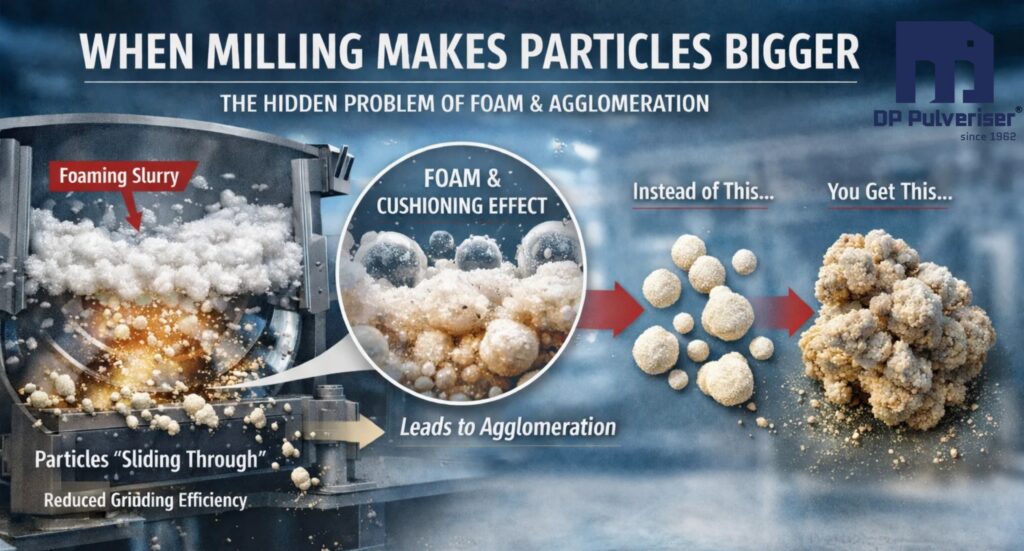
Foam-induced agglomeration occurs when a material undergoing milling begins to:
- Entrap air
- Generate foam due to surface-active compounds
- Form an aerated, low-density structure
Inside the mill, this creates a cushioning effect that prevents effective particle breakage.
Instead of fracturing:
- Particles absorb impact energy
- Fine particles adhere together
- Agglomerates grow in size
👉 The result is a reverse grinding phenomenon—where milling increases particle size instead of reducing it.
The Science Behind the Problem
1. Foam as an Energy Barrier
Foam acts as a shock absorber inside the mill.
In impact-based systems:
- Energy is dissipated through air pockets
- Particle-to-particle collisions are reduced
- Grinding efficiency drops significantly
2. Capillary Forces and Particle Binding
Even small amounts of moisture or liquid create:
- Capillary bridges between particles
- Surface tension forces
- Increased cohesion
This leads to wet or semi-wet agglomeration, even in systems that appear dry.
3. Surface Chemistry and Surfactants
Many industrial formulations include:
- Dispersants
- Wetting agents
- Binders
These components reduce surface energy barriers and promote particle adhesion, especially under mechanical stress.
4. Temperature and Softening Effects
During milling:
- Heat is generated
- Materials may approach their glass transition temperature (Tg)
This creates:
- Sticky particle surfaces
- Increased agglomeration tendency
Which Materials Are Most Affected?
This issue is commonly observed in:
Agrochemicals
- Wettable powders (WP)
- Water-dispersible granules (WDG)
- Surfactant-rich formulations
Pharmaceutical Powders
- API blends with excipients
- Spray-dried or amorphous materials
Food & Nutraceuticals
- Protein powders
- Flavor encapsulates
- Dairy-based ingredients
Specialty Chemicals
- Polymer additives
- Pigments and dyes
- Bio-based or fermentation-derived powders
Symptoms of Foam-Induced Milling Failure
If you’re seeing any of the following, this issue may be present:
- Particle size increases after milling
- Reduced throughput despite higher energy input
- Material “sliding” through the mill
- Excess dust combined with soft granules
- Inconsistent PSD (particle size distribution)
- Frequent screen or classifier inefficiencies
Why Traditional Fixes Don’t Work
Many operators attempt to correct the issue by:
- Increasing rotor speed
- Changing screens or classifier settings
- Running multiple passes
👉 These approaches fail because they treat the equipment, not the material behavior.
The root cause lies in: aeration, surface chemistry, and process conditions—not the mill itself.
Engineering Solutions: Fixing the Process, Not Just the Equipment
1. De-Aeration and Vacuum Conditioning
Removing entrained air prior to milling:
- Increases bulk density
- Improves energy transfer
- Eliminates foam formation
2. Pre-Conditioning with High-Intensity Mixing
Using systems like fluidized zone or plow mixers to:
- Break soft agglomerates
- Normalize feed consistency
- Reduce variability before milling
3. Switching Milling Technology
Impact mills are often the worst performers in these cases.
Better alternatives include:
- Shear-based milling (pin mills, wet mills)
- Compression-based systems
- Controlled classification systems
4. Temperature and Humidity Control
Managing process conditions to:
- Prevent softening
- Reduce stickiness
- Maintain consistent material properties
5. Cryogenic Milling (Advanced Applications)
For highly sensitive materials:
- Liquid nitrogen reduces temperature
- Eliminates tackiness
- Prevents agglomeration entirely
6. Controlled Feeding and Densification
Ensuring:
- Consistent feed rate
- Minimal air entrainment
- Proper material flow into the mill
Competitive Insight: Why Process Understanding Matters
Many equipment suppliers focus solely on machine specifications.
But solving this problem requires:
- Understanding material science
- Controlling process conditions
- Integrating multiple technologies
This is where integrated systems—like those engineered across the Proc-X platform—outperform standalone solutions from companies such as Hosokawa Micron Group.
Real-World Impact
Addressing foam-induced agglomeration can:
- Increase throughput by 20–50%
- Improve particle size consistency
- Reduce rework and waste
- Enhance downstream processing performance
- Lower total operating costs
Conclusion: You’re Not Milling—You’re Managing Physics
When foam and aeration enter the equation, milling stops being a mechanical process and becomes a material behavior challenge.
👉 If your product is foaming, you’re not transferring energy—you’re absorbing it.
And until that changes, particle size reduction will remain inefficient or even impossible.
About Proc-X
Proc-X Manufacturing Group integrates:
- Milling (DP Pulverizers)
- Mixing (PerMix)
- Material Handling (AIS)
- Extrusion & Process Systems
Delivering complete, engineered solutions for complex material challenges across industries.