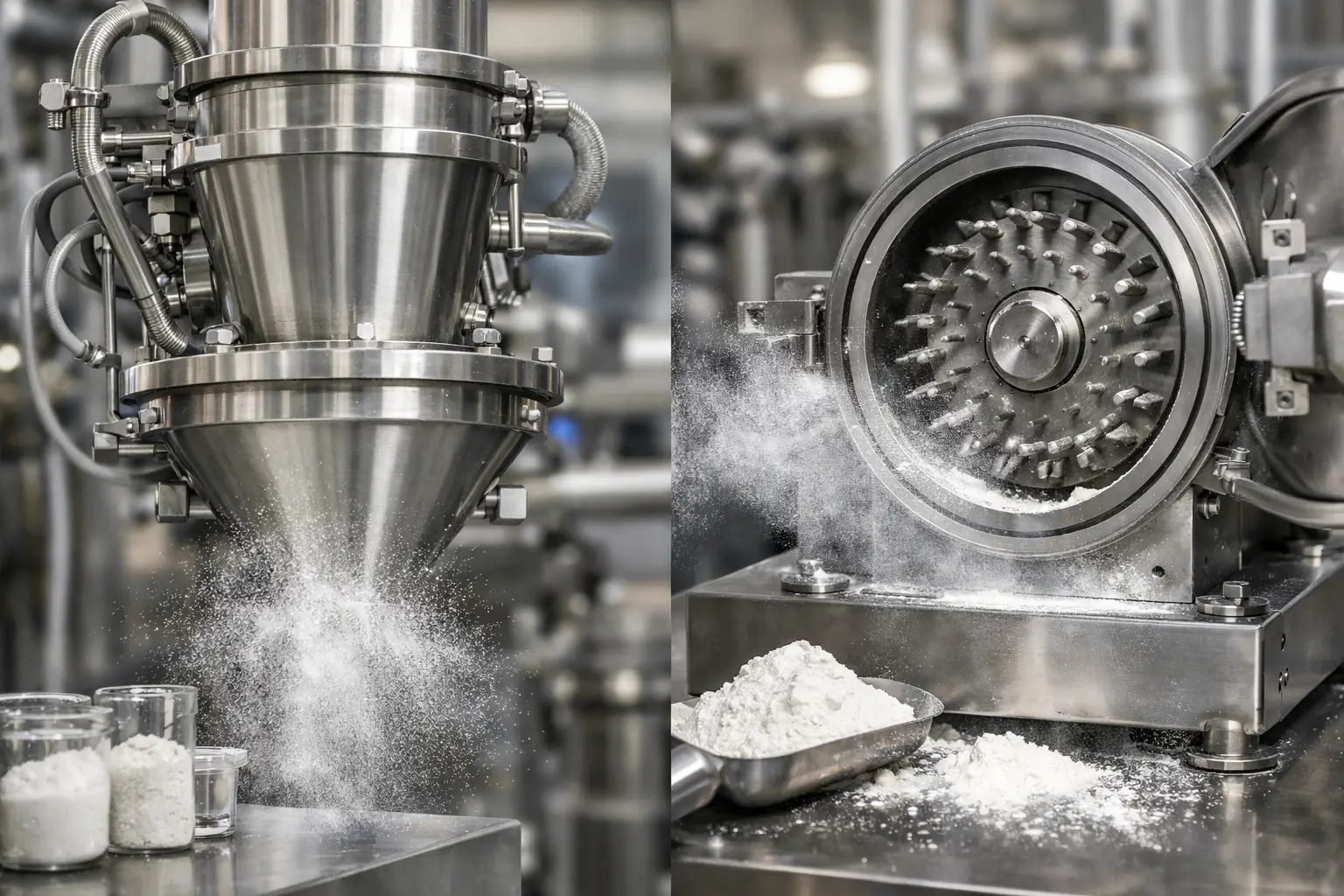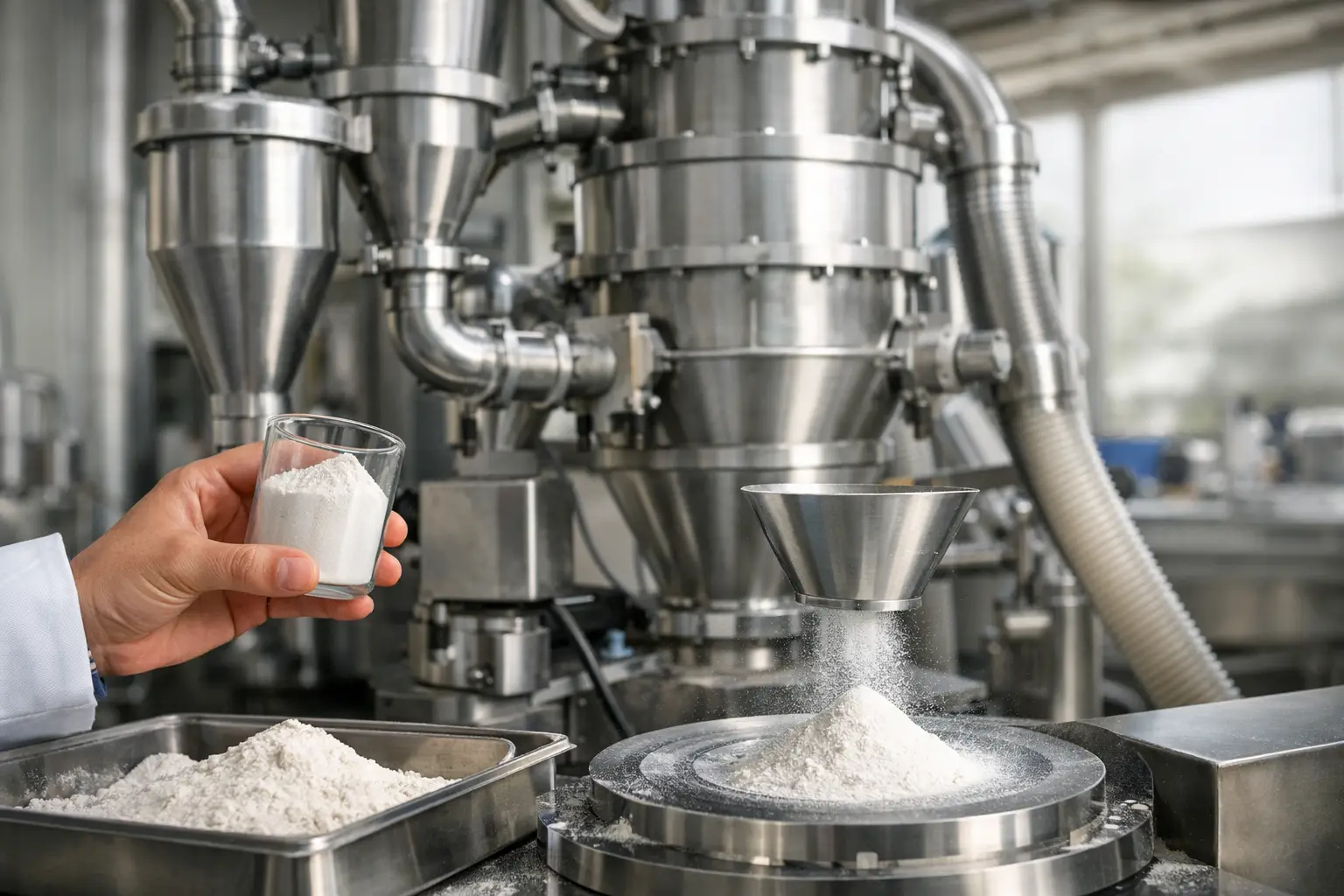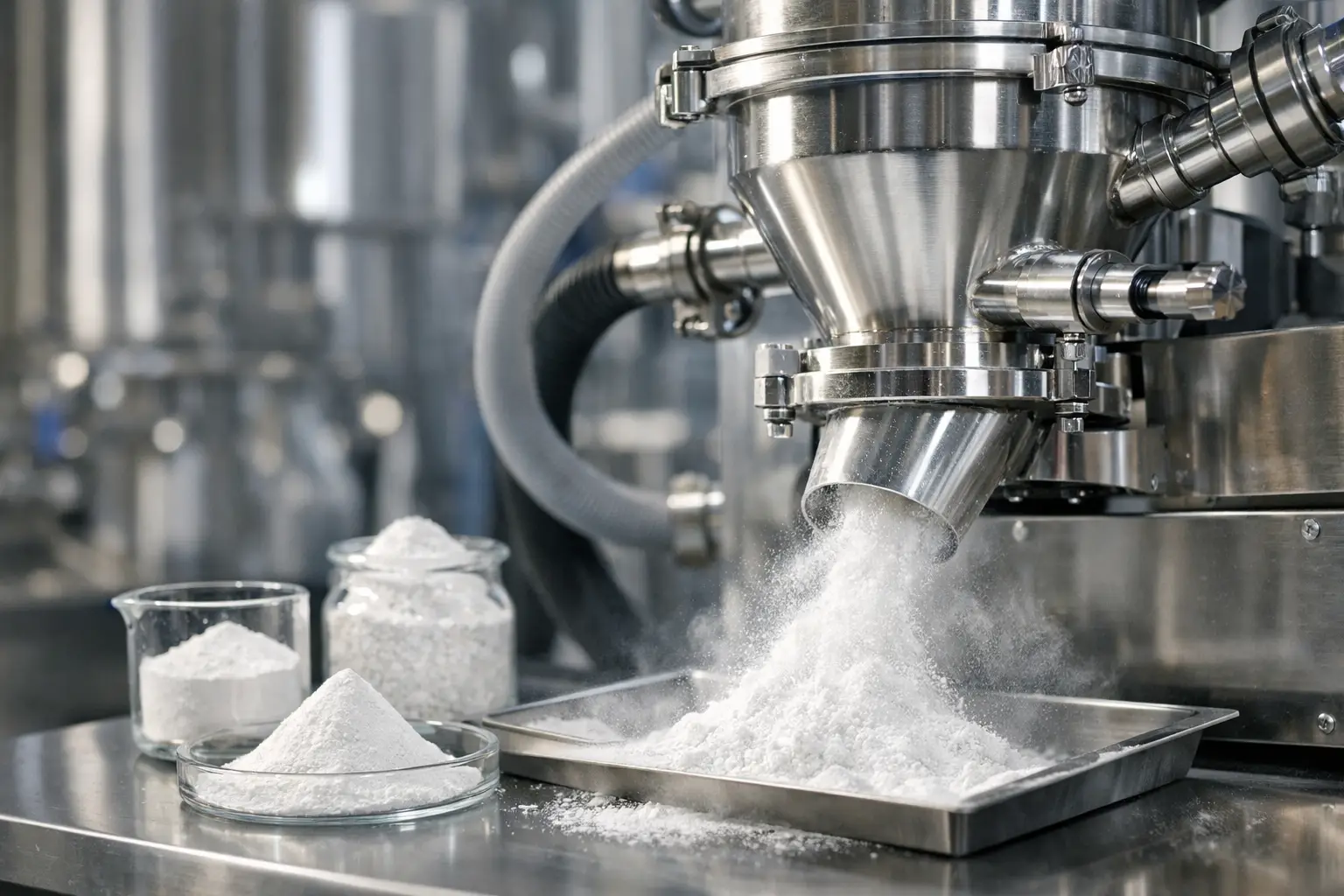
Particle size is rarely a minor variable in manufacturing. It affects dissolution, flowability, mixing, bulk density, reaction rates, finished product consistency, and even downstream packaging performance. That is why understanding the types of size reduction matters well before equipment is specified or a line is expanded. The right method improves control and throughput. The wrong one can create heat, fines, contamination, or an unstable process that never quite performs as expected.
In industrial powder processing, size reduction is not a single operation with a single outcome. Different milling technologies apply different mechanical forces to break material down, and those forces interact with each feed material in specific ways. Hardness, brittleness, moisture, temperature sensitivity, abrasiveness, and target particle distribution all influence which approach will perform best.
What the types of size reduction actually mean
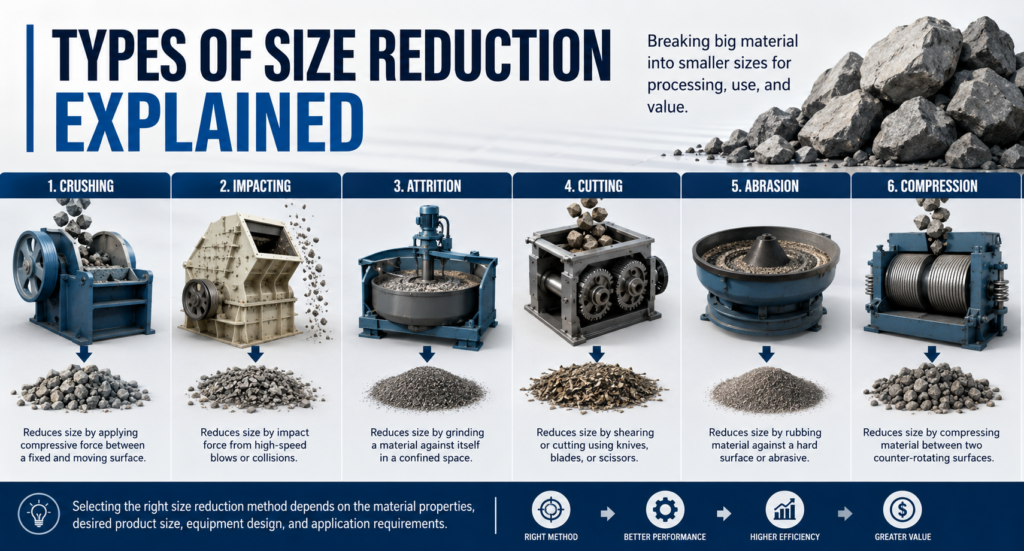
At a process level, the main types of size reduction are usually defined by the dominant force used to reduce particle size. These forces include compression, impact, attrition, shear, and cutting. Many real-world mills use more than one force at the same time, but one mechanism usually drives the result.
This distinction matters because materials do not fail the same way under stress. A friable mineral may respond efficiently to impact. A fibrous botanical may resist impact but break down more effectively through shear or cutting. A heat-sensitive active ingredient may require a lower-energy approach or temperature-controlled system to preserve product integrity.
For engineers and operations teams, the practical question is not just how to make particles smaller. It is how to produce the required particle size distribution with acceptable yield, throughput, energy use, and contamination control.
Compression, impact, attrition, shear, and cutting
Compression size reduction
Compression reduces particle size by applying pressure between two surfaces until the material fractures. This mechanism is common in applications handling harder or more brittle materials, especially at coarser reduction stages.
Compression can be effective and energy-efficient for the right feed, but it is generally less suitable when a tight fine-particle distribution is required. It may also offer less flexibility for materials that deform rather than fracture cleanly. In a broader process line, compression is often used upstream of finer milling equipment.
Impact size reduction
Impact breaks particles by striking them at high speed. Hammer mills and many high-speed rotor-based systems rely heavily on this principle. For friable materials, impact can deliver strong throughput and relatively straightforward operation.
The trade-off is that impact can generate heat and a wider particle size distribution if the system is not well matched to the material. It may also increase fines generation, which can be a problem in applications where dust, yield loss, or downstream segregation must be minimized.
Attrition size reduction
Attrition reduces particles through rubbing or abrasion between surfaces or between particles. This mechanism is often associated with finer grinding applications, especially where controlled reduction is more important than aggressive throughput.
Attrition can support narrower particle distributions in some materials, but performance depends heavily on feed consistency and machine configuration. For certain products, attrition offers better control than pure impact. For others, it may limit capacity or create unnecessary residence time.
Shear size reduction
Shear uses opposing forces that cause the material to slide and tear apart. This is particularly useful for materials that are tough, elastic, fibrous, or prone to smearing under impact alone.
Shear-based reduction is often a better fit where product handling characteristics matter as much as final micron size. In food, nutraceutical, and some specialty chemical applications, shear can help maintain a more stable process when the feed does not respond predictably to brittle fracture.
Cutting size reduction
Cutting is a more direct form of mechanical reduction in which sharp edges slice material into smaller pieces. It is typically used for fibrous, stringy, or sheet-like materials rather than free-flowing brittle powders.
Cutting is not usually the final step for fine powder production, but it can be essential as a pre-break operation. It prepares difficult feedstock for secondary milling and helps prevent inefficiencies that occur when oversized or irregular material enters a fine grinding system.
Types of size reduction by milling technology
In actual production environments, manufacturers usually evaluate the types of size reduction through equipment categories rather than force diagrams. That is where application knowledge becomes critical.
Hammer mills
Hammer mills primarily use impact. They are commonly selected for coarse to medium grinding and can handle a wide range of materials with good throughput. They are often a practical choice when simplicity and production rate are priorities.
Their limitations appear when tighter top-size control, lower heat generation, or narrower particle distribution is required. For heat-sensitive, sticky, or highly abrasive materials, another technology may be a better fit.
Pin mills
Pin mills use high-speed impact and some attrition between rotating and stationary pins. They are often used for finer size reduction than hammer mills and can produce more uniform results on many dry, friable materials.
They perform well in food, chemical, and mineral applications, but they are not ideal for every product. Sticky feeds or materials with high fat content can reduce efficiency and increase buildup.
Air classifier mills
Air classifier mills combine impact milling with internal particle classification. This allows oversize particles to remain in the grinding zone while finer material exits once it meets the target cut point.
For manufacturers seeking tighter control over particle size distribution, this approach can be highly effective. It also reduces dependence on external screening. The trade-off is greater system complexity compared with simpler impact mills.
Jet mills
Jet mills reduce particle size through high-velocity particle-to-particle impact in a fluid energy stream. Because there are no high-speed mechanical grinding elements in the milling chamber, they are well suited for applications requiring very fine particle sizes, low contamination, and careful thermal control.
They are widely used in pharmaceutical, specialty chemical, battery, and advanced material processing. However, jet milling is not the most economical choice for every application. Feed properties, compressed gas requirements, and target throughput all affect the business case.
Cone mills and universal mills
Cone mills often rely on a combination of gentle impact and shear. They are frequently used for deagglomeration, delumping, and controlled particle reduction where product integrity matters. In pharmaceutical and nutraceutical processing, they are often selected for predictable handling and repeatability.
Universal mills offer flexibility by supporting multiple grinding elements and operating modes. That flexibility can be valuable in facilities processing different products, but optimal performance still depends on selecting the right internal configuration for the material.
Cryogenic grinding systems
Some materials become far easier to reduce when they are cooled to very low temperatures. Cryogenic grinding changes the material behavior by making heat-sensitive, elastic, or smear-prone products more brittle before or during milling.
This is often the best path for spices, plastics, elastomers, certain chemicals, and other temperature-sensitive products. It adds system complexity and operating cost, but it can solve problems that conventional ambient grinding simply cannot.
How to choose among the types of size reduction
Equipment selection should start with the material, not the machine. Feed size, hardness, brittleness, abrasiveness, moisture level, bulk density, temperature sensitivity, and explosibility all influence the reduction mechanism that will work best.
The target result matters just as much. A process designed for deagglomeration is different from one designed for micronization. A line that needs high throughput at a moderate particle range will likely favor different equipment than a process requiring ultra-fine particles with tight distribution and minimal contamination.
Operational factors also shape the decision. Throughput expectations, cleanability, wear resistance, dust containment, energy consumption, maintenance access, and integration with feeders, classifiers, and conveying systems can make one technology far more practical than another.
This is where many projects run into trouble. A mill may be technically capable of reaching a target particle size in lab testing, yet still underperform in production because the complete system was not designed around the application. Residence time, air handling, heat buildup, feeding consistency, and downstream transfer all affect real-world results.
Why process testing matters
No chart can fully predict how a material will behave under stress. Two powders with similar starting sizes may respond very differently because of particle shape, elasticity, moisture, or internal structure.
That is why process development and application testing are so valuable when evaluating the types of size reduction. Testing helps confirm achievable particle size distribution, identify heat or contamination risks, evaluate throughput, and determine whether the material requires impact, attrition, classification, or temperature-controlled grinding.
For manufacturers scaling from pilot to production, testing also helps avoid a common mistake: selecting equipment based only on target micron size without considering yield, uptime, wear, or long-term operating cost. The best system is not the one that only reaches spec. It is the one that reaches spec consistently under production conditions.
Different types of size reduction can all produce smaller particles. The real objective is to produce the right particles, at the right rate, with the right level of control for the application. When equipment selection is driven by material behavior and process performance rather than generic categories, the result is a more stable operation and a better long-term return. If your application involves difficult feed materials, narrow specifications, or scale-up uncertainty, that is the point where engineering guidance becomes far more valuable than a simple equipment comparison.