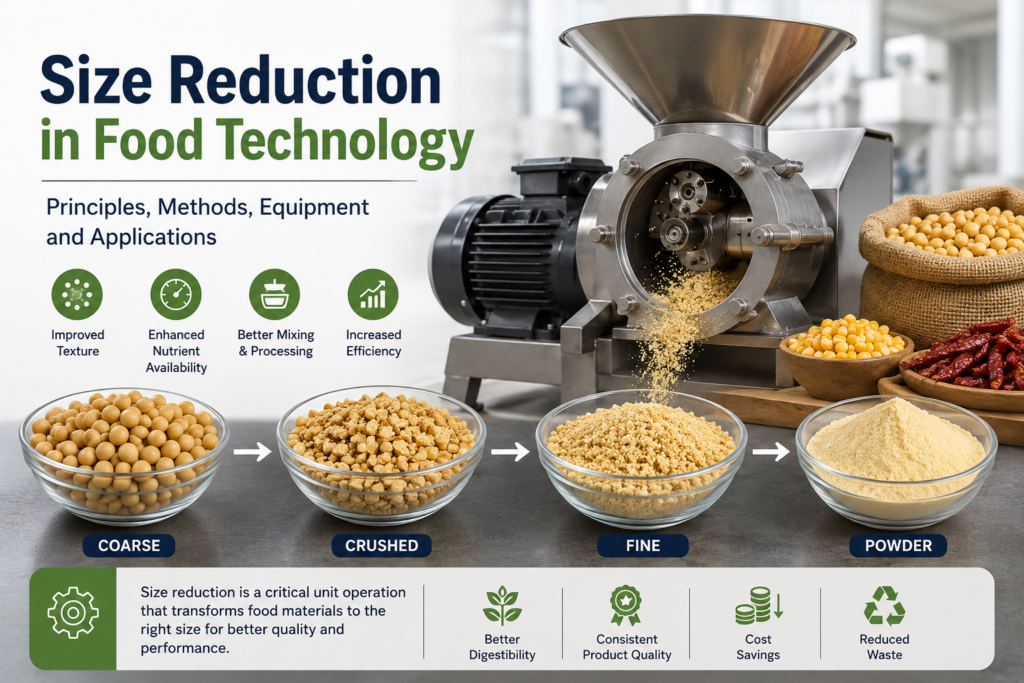
A spice line that drifts out of spec by a few hundred microns can create bigger problems than most teams expect. Flow changes, blend uniformity drops, packaging performance suffers, and the finished product no longer behaves the way R&D intended. That is why size reduction in food technology is not just a grinding step. It is a process decision that directly affects product quality, plant efficiency, sanitation, and long-term operating cost.
In food manufacturing, particle size influences far more than appearance. It affects mouthfeel, solubility, hydration rate, bulk density, dispersion, flavor release, and shelf stability. For operations teams, it also affects throughput, dust generation, cleaning time, and wear on downstream equipment. When size reduction is approached as an engineered process rather than a commodity utility, the production line usually becomes more stable and more predictable.
Why size reduction in food technology matters
Food products rarely start in the form the process needs. Sugar may need to become a fine powder for icing blends. Spices may need controlled milling for consistent flavor distribution. Cereals, grains, dehydrated vegetables, proteins, and specialty ingredients often need particle reduction to meet mixing, cooking, conveying, or packaging requirements.
The challenge is that reducing particle size also changes material behavior. A friable ingredient may mill easily but produce excessive fines. A heat-sensitive ingredient may smear, discolor, or lose volatile compounds if the wrong technology is used. Oily or fibrous products can resist clean fracture and instead pack, agglomerate, or foul the mill. The right solution depends on what the material does under stress, not simply on the target micron range.
This is where process knowledge matters. Two products may share a nominal feed size yet require entirely different milling approaches because of fat content, moisture, stickiness, temperature sensitivity, or hygiene requirements. In food processing, there is rarely a universal answer.
The core objective is controlled particle size, not just smaller particles
Many production issues begin when the goal is defined too loosely. Making particles smaller is easy. Producing the right particle size distribution, at the required throughput, without damaging the product or creating sanitation problems, is the real objective.
A narrow particle size distribution can improve blend uniformity and product consistency. It can also support more reliable dosing, conveying, and filling. But tighter control sometimes comes with trade-offs. Finer grinding may increase energy demand, heat generation, and dust loading. It may also reduce yield if too much material falls below the usable range.
That is why food processors typically evaluate size reduction based on several performance factors at once: target particle size, distribution width, throughput, temperature rise, contamination risk, and cleanability. A mill that achieves the desired fineness but creates excessive heat or long cleaning cycles may not be the right production choice.
Common milling technologies used in food processing
Different technologies reduce particle size in different ways. Impact mills, such as hammer mills and pin mills, are often selected for products that fracture well and need efficient throughput. They can be highly effective for many dry food ingredients, but material sensitivity and required fineness will determine whether they are the best fit.
Air classifier mills combine size reduction and classification in a single system. That makes them useful when tighter particle size control is needed and when oversize recirculation supports a more uniform final product. For food manufacturers targeting more precise distributions, this approach can offer a meaningful process advantage.
Jet mills are often used for finer applications where contamination control and reduced mechanical contact are priorities. They can be especially useful for heat-sensitive or high-value ingredients, although operating cost and compressed gas requirements need to be evaluated carefully.
Cone mills and universal mills are commonly selected where gentle deagglomeration, controlled granulation, or flexible processing is required. Cryogenic grinding can be the better option for spices, high-fat products, or other materials that become difficult to mill as temperature rises. By lowering product temperature, cryogenic systems can help preserve volatile compounds and improve fracture characteristics.
The best technology depends on the application. Throughput targets, sanitary design requirements, ingredient behavior, and the acceptable process window all shape the decision.
Material characteristics drive equipment selection
In practice, the ingredient usually tells you what the mill needs to do. Hard crystalline materials behave differently from soft, elastic, fibrous, or oily products. Moisture content is a major factor. So is fat level. A dry sugar-based ingredient may process efficiently in an impact mill, while a spice with higher oil content may require lower temperature grinding to prevent smearing and screen blinding.
Feed size matters as well. If incoming material is highly variable, the mill may see inconsistent loading that affects final particle size and throughput. In those cases, upstream conditioning or pre-breaking can improve performance across the full line.
Bulk density, abrasiveness, and sensitivity to metal contamination also influence system design. For some food applications, the milling chamber is only one part of the solution. Feeding method, air handling, dust collection, discharge design, and classifier settings may determine whether the process performs consistently day after day.
Heat, contamination, and hygiene are process-critical
Food size reduction is not only about mechanical performance. It is also about preserving product integrity in a controlled sanitary environment.
Heat is one of the most common problems. Excessive temperature rise can affect flavor, aroma, color, nutritional profile, and flowability. It can also create buildup inside the mill, increasing downtime for cleaning and raising the risk of inconsistent production. In some applications, a lower-energy grinding approach or temperature-controlled system delivers better overall performance than simply forcing higher throughput.
Contamination control is equally important. Wear-resistant materials, proper sealing, and the right internal geometry can reduce the risk of foreign material introduction. For processors working under strict food safety programs, cleanability and hygienic design should be evaluated as seriously as particle size capability. Dead zones, difficult disassembly, and poor access for inspection can turn an otherwise capable mill into an operational liability.
This is where engineering matters. A system designed for food use should support not just production targets, but also sanitation procedures, validation requirements, and practical maintenance intervals.
Scaling from pilot to production without losing control
One of the more costly mistakes in size reduction in food technology happens during scale-up. A material that behaves well in pilot trials can respond differently at commercial throughput because residence time, feed consistency, air flow, and thermal loading all change.
Successful scale-up depends on more than matching motor horsepower. It requires understanding how the chosen technology will perform under real operating conditions, including sustained production rates, cleaning frequency, and shifts in raw material variability. When scale-up is handled correctly, the result is a process that maintains particle size, yield, and uptime rather than forcing repeated adjustments after installation.
For manufacturers launching new products or modernizing existing lines, this is often the point where customized process support becomes valuable. A system tailored to the product and production environment will generally outperform a standard one-size-fits-all configuration, especially in demanding food applications.
What to evaluate before selecting a food milling system
The best equipment decisions usually come from asking better process questions. What final particle size and distribution are actually required? How much heat can the product tolerate? Does the ingredient tend to smear, cake, or absorb moisture? What sanitation standard must the system support? How often will recipes change? What happens to throughput when screens, hammers, pins, or classifiers begin to wear?
These are not minor details. They determine whether the system will support reliable production or become a bottleneck. Capital cost matters, but long-term value is usually shaped by uptime, maintenance burden, yield, energy use, and how consistently the line runs within spec.
For many processors, the right answer is not the most aggressive mill. It is the system that delivers repeatable particle control with manageable operating cost and dependable sanitation performance. That balance is where real manufacturing value is created.
DP Mills works with manufacturers facing exactly these decisions across demanding powder processing environments, where precision, throughput, and process reliability all have to work together.
A well-engineered size reduction process should make the rest of the plant easier to run. When particle size is controlled with the right technology and the right process conditions, quality improves, troubleshooting drops, and production gains room to scale with confidence.