Jet Mills for API Micronization
Precision particle size reduction for pharmaceutical manufacturing
Active Pharmaceutical Ingredients (APIs) live or die by particle size. Dissolution rate, bioavailability, content uniformity, flowability, and even regulatory acceptance all hinge on how precisely those particles are controlled. That’s where jet mills for API micronization earn their reputation as the gold standard.
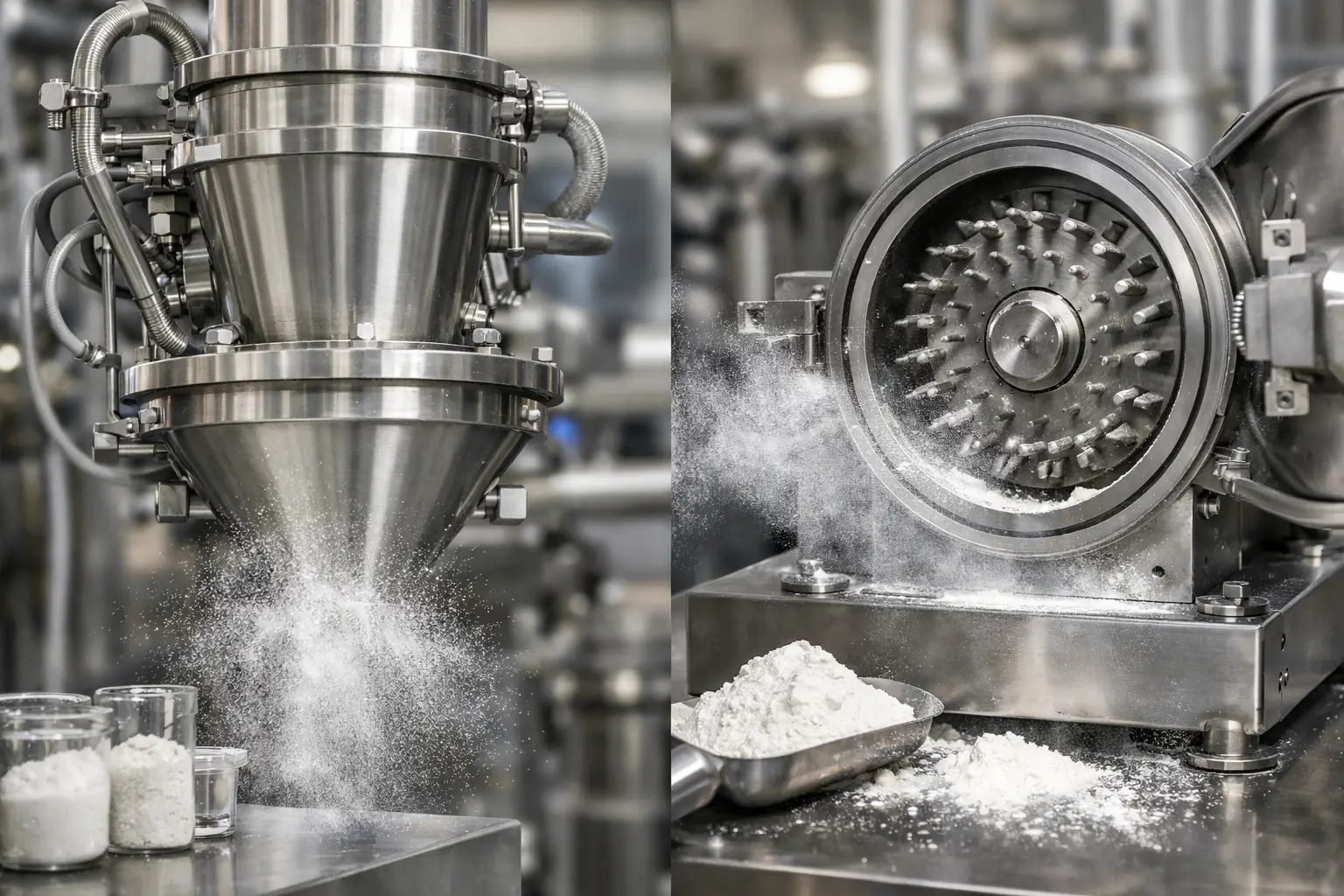
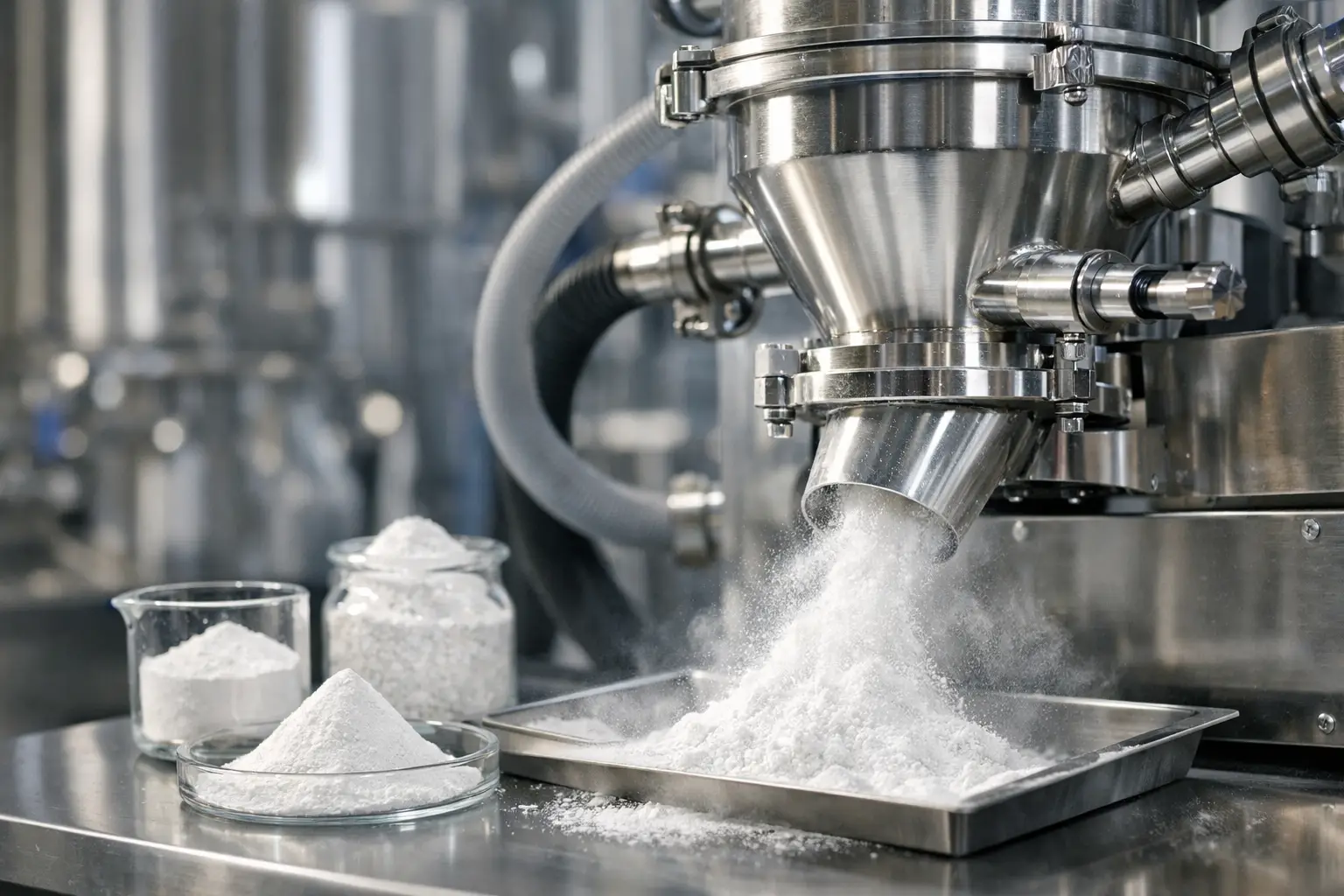
Jet milling uses high-velocity gas streams—not mechanical grinding—to reduce APIs down into the micron and sub-micron range. No grinding media. No metal-to-metal contact. No unnecessary heat. Just physics doing elegant, repeatable work.
What Is API Micronization?
API micronization is the controlled reduction of drug substance particles, typically into the 1–10 micron range, to improve:
- Bioavailability of poorly soluble APIs
- Dissolution rate and absorption consistency
- Blend uniformity for low-dose formulations
- Stability and reproducibility across batches
Jet mills are uniquely suited for this task because they rely on particle-to-particle collision driven by compressed air or inert gas, rather than mechanical force.
How Jet Mills Micronize APIs
Inside a pharmaceutical jet mill, compressed gas accelerates particles to supersonic velocities. As particles collide with one another, they fracture along natural fault lines. An integrated air classifier continuously rejects oversized particles, ensuring only material that meets the target cut point exits the system.
The result is a tight particle size distribution without thermal degradation or contamination risk.
Key advantages of this mechanism:
- No milling media to contaminate the API
- Minimal heat generation for thermally sensitive compounds
- Extremely narrow and repeatable PSD control
Why Jet Mills Are Ideal for Pharmaceutical APIs
Jet milling isn’t just preferred in pharma—it’s often required. For regulated environments, the advantages are hard to argue with:
Ultra-clean processing
No mechanical contact means minimal wear and virtually zero risk of metallic contamination.
Low-temperature operation
Critical for heat-sensitive or amorphous APIs that degrade under mechanical milling.
Precise particle control
Classifier-controlled cut points enable consistent micronization from batch to batch.
Scalable from R&D to production
Process parameters translate cleanly from lab-scale systems to full commercial throughput.
Typical API Applications for Jet Mills
Jet mills are commonly used for:
- Poorly soluble APIs requiring bioavailability enhancement
- High-potency compounds where containment is critical
- Low-dose formulations needing exceptional blend uniformity
- Inhalation and pulmonary drug delivery powders
- Controlled-release and specialty formulations
Whether the goal is faster dissolution or tighter content uniformity, jet milling gives formulation scientists the control they need.
Pharmaceutical Design Considerations
Modern API jet mills are engineered specifically for regulated environments, with features such as:
- Pharmaceutical-grade stainless steel construction
- Smooth internal surfaces for easy cleaning and validation
- CIP/WIP-ready designs
- Inert gas operation for oxygen-sensitive APIs
- Containment options for potent compounds
- Validation documentation support (IQ/OQ readiness)
These systems integrate seamlessly into GMP manufacturing workflows without compromise.
Jet Milling vs Mechanical Milling for APIs
Mechanical mills rely on impact, shear, or compression—all of which introduce heat, wear, and variability. Jet mills, by contrast, are self-classifying, low-energy at the product level, and exceptionally repeatable.
If particle integrity, purity, and regulatory confidence matter—and in pharma they always do—jet milling stands apart.
The Takeaway
Jet mills for API micronization are not just size-reduction tools; they are process-enabling technologies. They help pharmaceutical manufacturers unlock better bioavailability, tighter specifications, cleaner processing, and scalable production—all while meeting the demanding expectations of modern drug development.
In a world where microns decide market success, jet mills quietly do the heavy lifting—with nothing more than air, precision engineering, and a deep respect for physics.