What Is a Pin Mill and How Does It Work?
When it comes to precision grinding and fine powder production, pin mills are one of the most versatile and efficient solutions available. They’ve become a trusted tool across industries like food, pharmaceuticals, chemicals, and minerals because of their ability to deliver uniform, consistent particle sizes without excessive heat build-up or product degradation. But what exactly is a pin mill, and how does it work?
Understanding the Pin Mill
A pin mill is a type of size-reduction equipment that uses high-speed impact between pins to break down materials. Unlike hammer mills, which rely on swinging hammers, or jet mills, which use compressed air, a pin mill uses a rotor and stator disc lined with rows of pins.
- The Rotor: Spins at high speeds, typically thousands of RPMs.
- The Stator: A stationary disc with pins facing inward.
- The Interaction: As material is fed into the grinding chamber, it is impacted by the rotating pins and the stationary pins, creating particle-to-particle collisions that reduce the size of the material.
This impact-and-shear mechanism produces a narrow particle size distribution, making pin mills ideal for achieving fine and uniform powders.
Key Features of Pin Mills
- Fine Grinding Capabilities: Achieves particle sizes from medium to ultra-fine (down to a few microns).
- Temperature Control: Low heat generation makes them suitable for heat-sensitive products like cocoa, flour, and pharmaceuticals.
- Easy Cleaning & Maintenance: Pin mills can be designed for quick disassembly, making them a favorite in sanitary industries like food and pharma.
- Versatility: They handle brittle, fibrous, and even slightly oily materials.
Pin Mills in Action
Pin mills are widely used in:
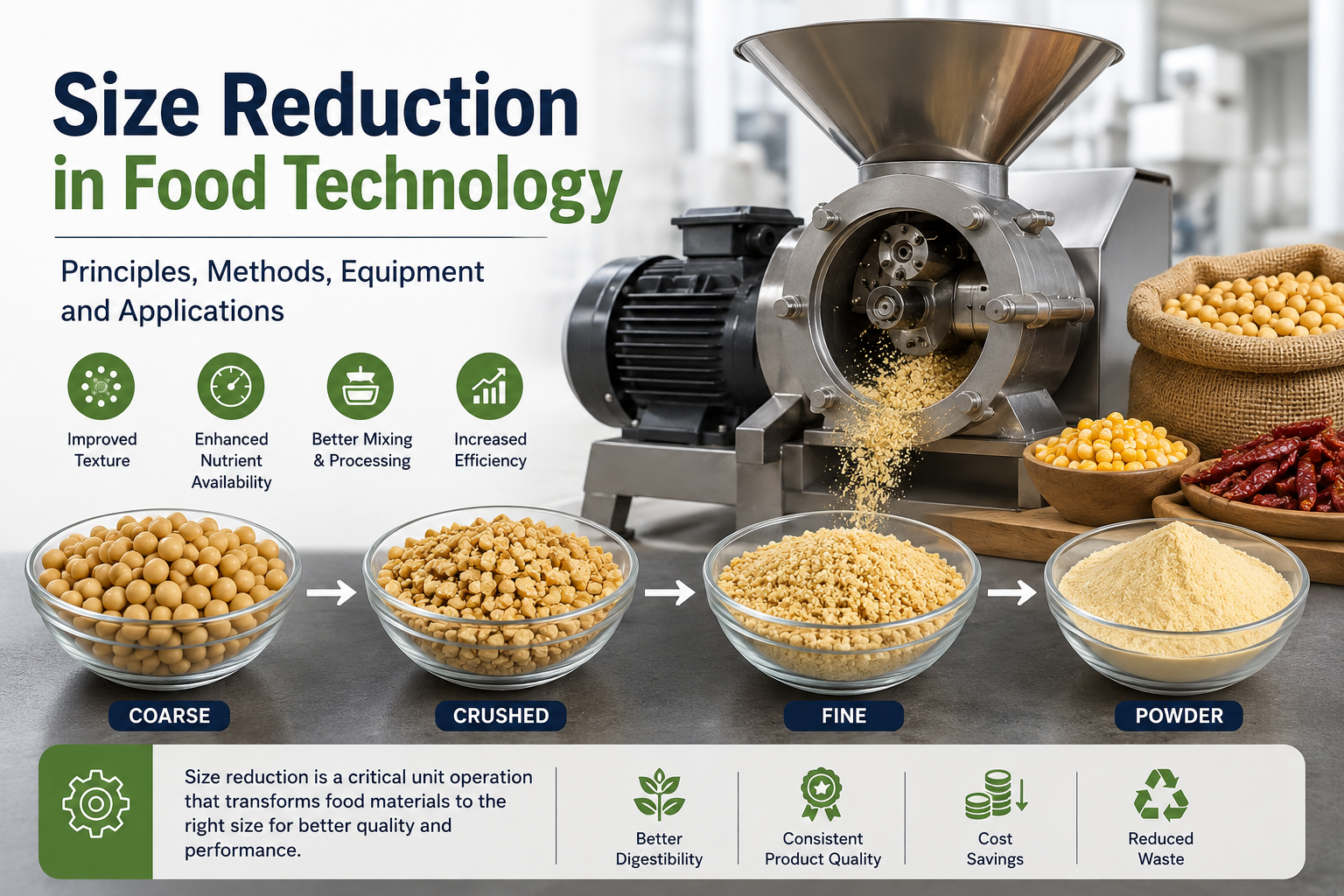
- Food Processing: Grinding sugar, spices, starches, proteins, and specialty flours.
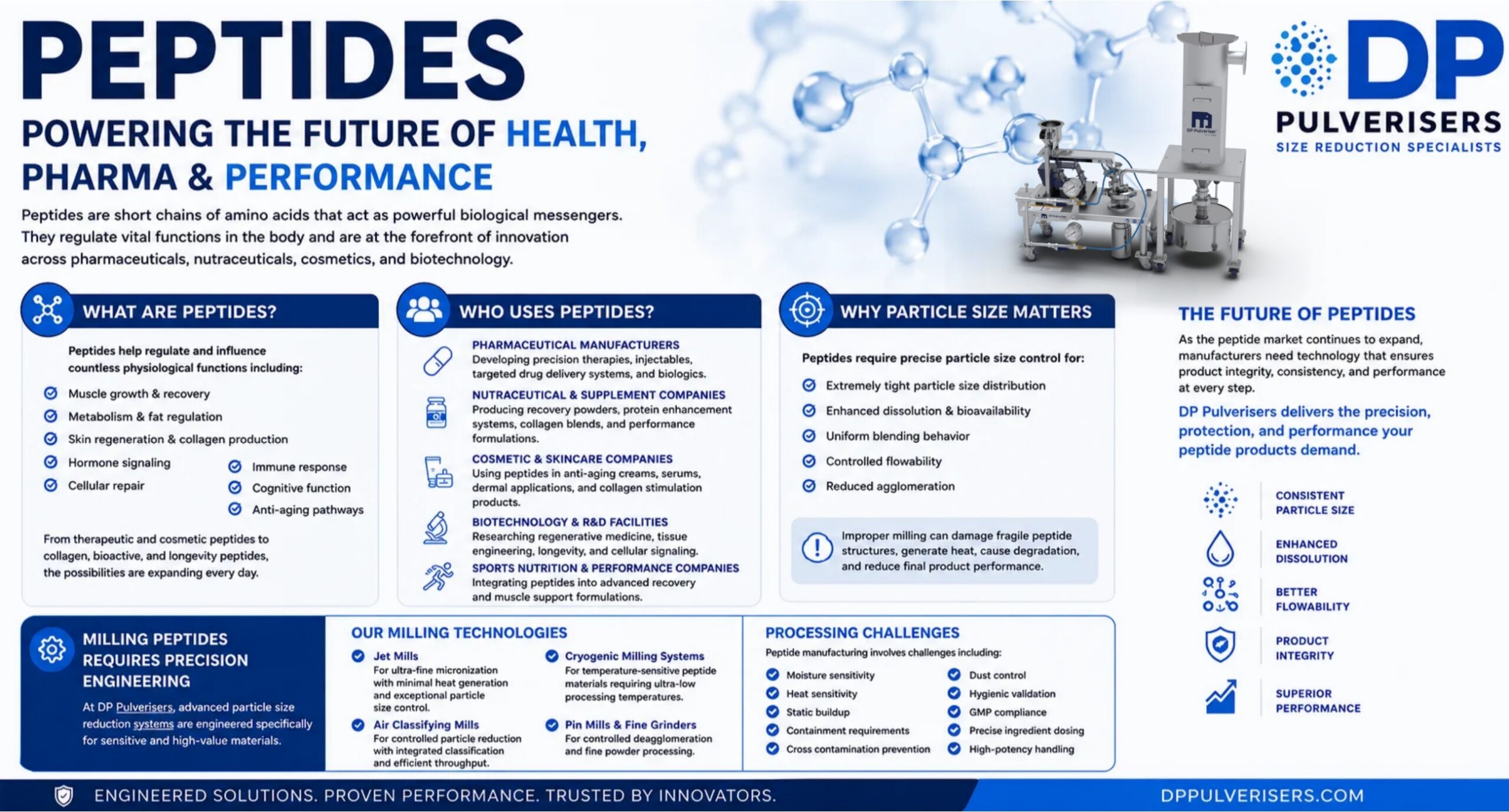
- Pharmaceuticals: Micronizing active ingredients and excipients.
- Chemicals: Producing fine powders like pigments, resins, and polymers.
- Minerals: Processing talc, calcium carbonate, and other fine mineral powders.
How DP Pulverizers Elevates Pin Milling
At DP Pulverizers, we don’t just manufacture pin mills — we engineer them around your process requirements. Our pin mills are designed with:
- Customizable Speed & Pin Configurations to achieve the exact particle size distribution you need.
- Wear-Resistant Construction using stainless steel, Hastelloy, or Hardox for demanding applications.
- Sanitary Designs that comply with FDA, GMP, and CIP standards for food and pharma.
- Safety Options including explosion-proof (ExP/ATEX) builds, cooling jackets, and inert gas systems.
With a global track record across industries, DP Pulverizers delivers not just equipment, but complete milling solutions — from stand-alone pin mills to fully integrated systems with conveyors, sifters, and dust collectors.
Conclusion
Pin mills are a powerful and efficient solution for fine grinding, offering precision, versatility, and safety. Whether you’re producing spices, APIs, or specialty chemicals, a pin mill can help you achieve the results you need. And with DP Pulverizers’ engineered solutions, you gain more than a mill — you gain a partner in performance.
👉 Explore our full range of pin mills at www.dpmills.com and discover how DP Pulverizers can meet your milling challenges with precision and reliability.