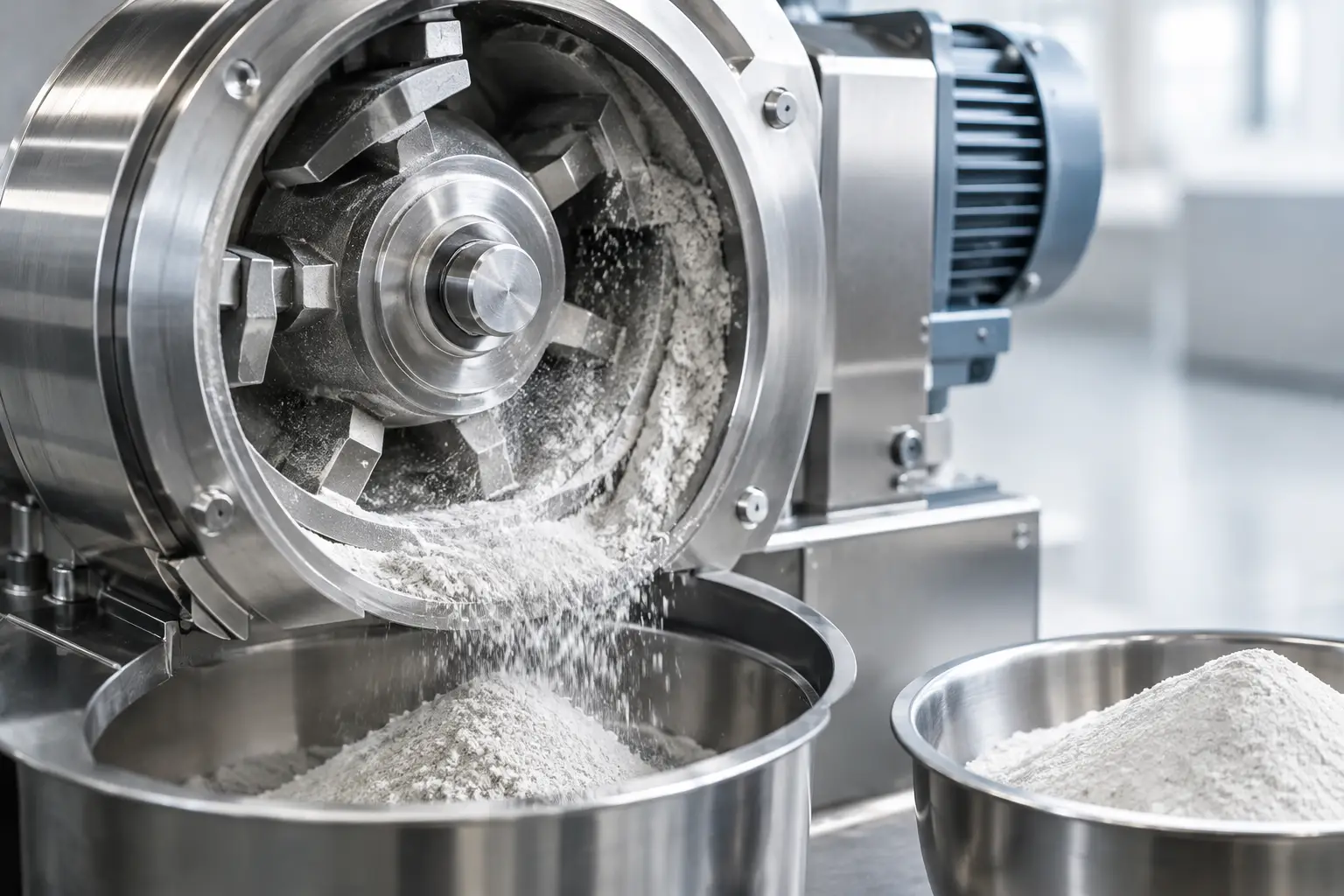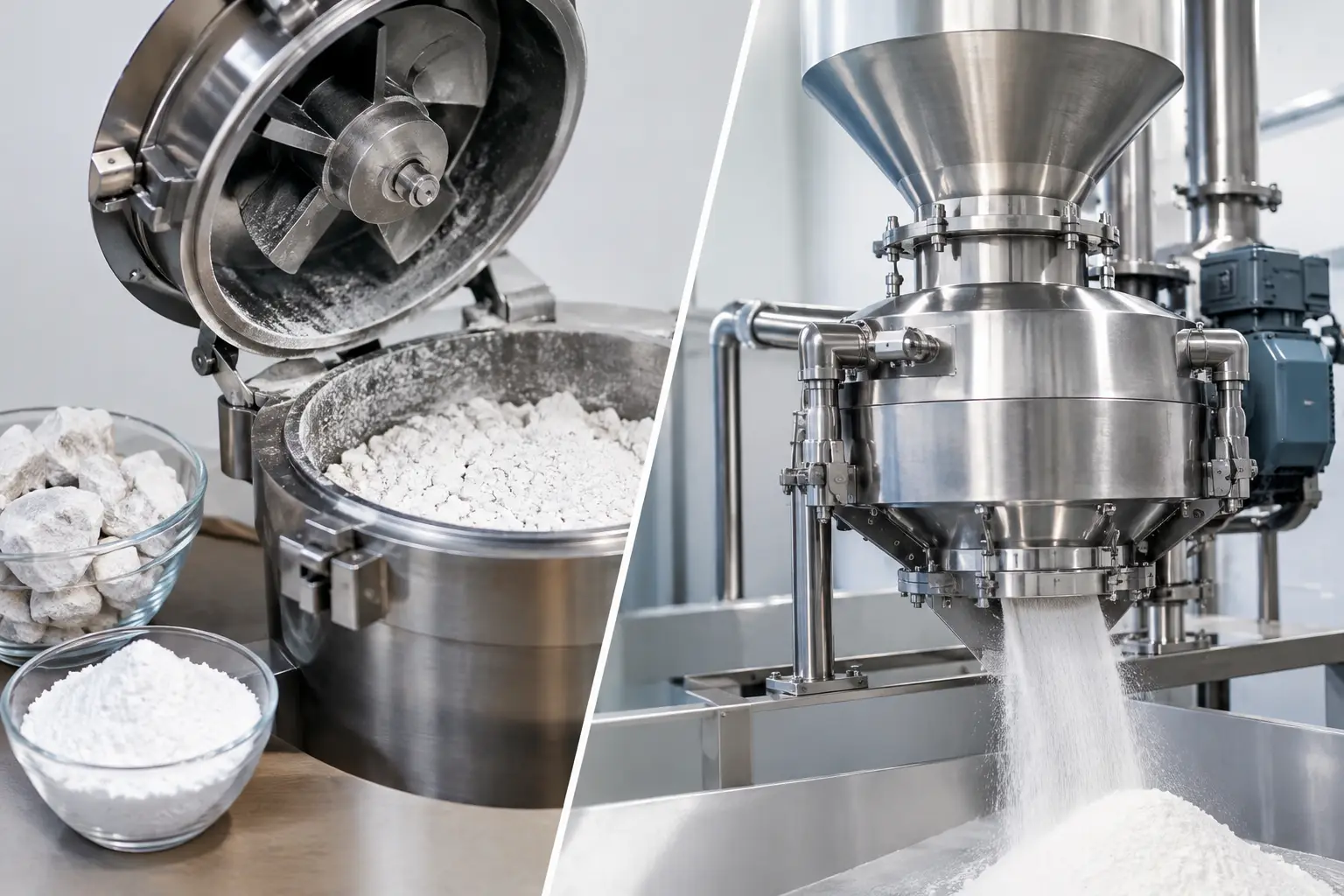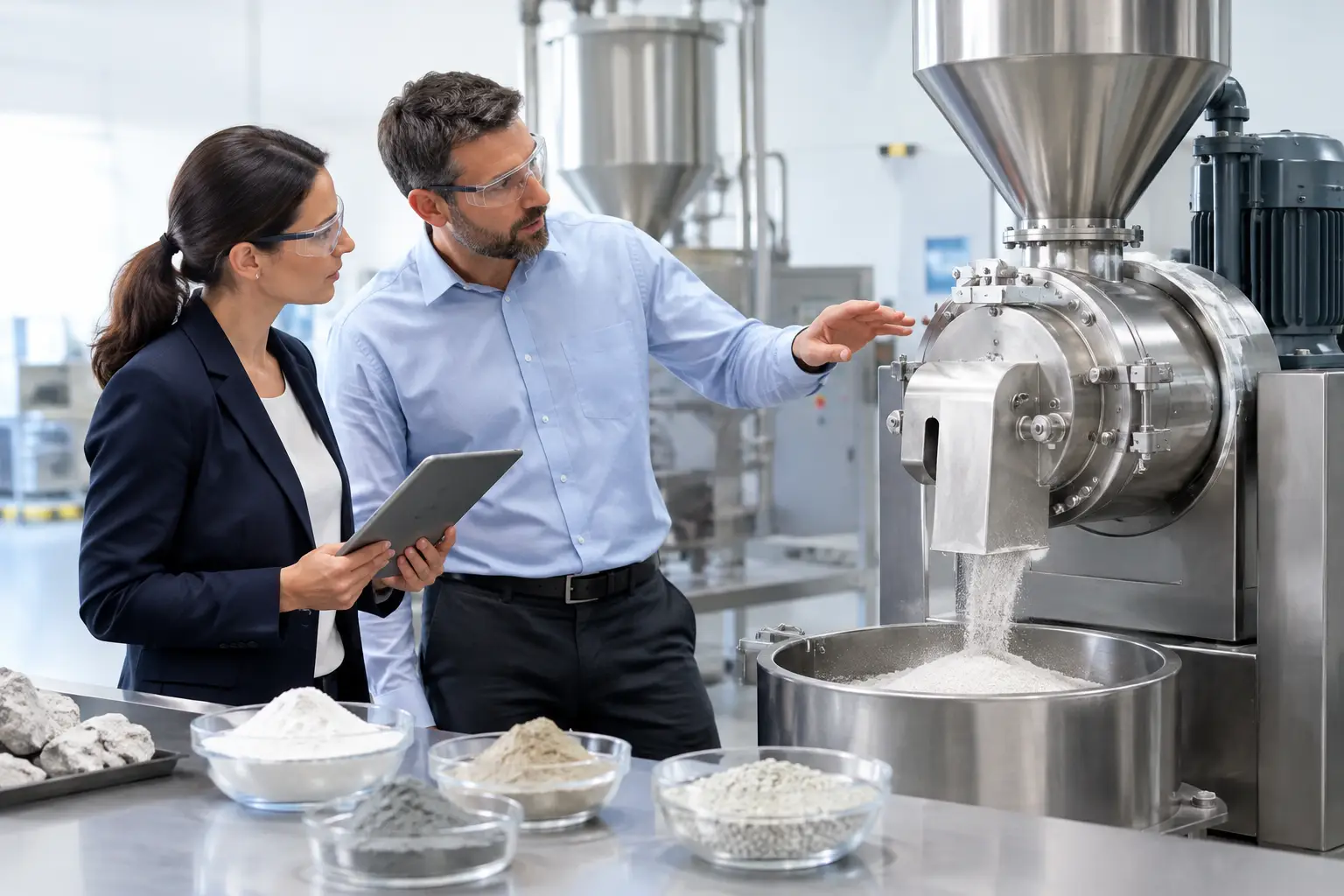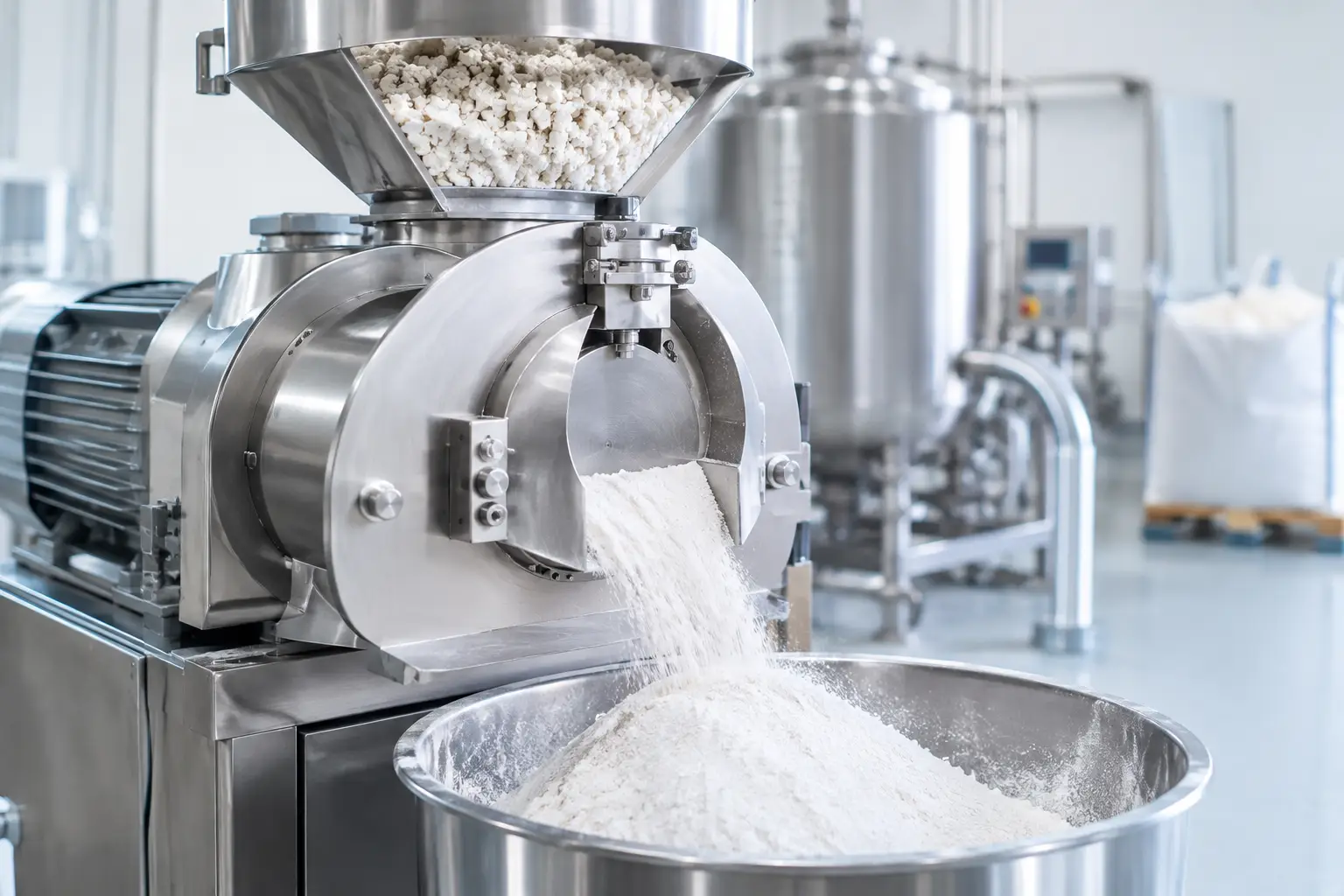
A powder can meet its particle size specification and still create a costly production problem. Milling bulk density influences how material feeds into the mill, moves through pneumatic conveying, fills packages, responds to classification, and behaves at the next process step. For manufacturers working with tight quality, throughput, or containment requirements, density is not a secondary lab value. It is a process variable that must be understood alongside particle size distribution, moisture, flowability, and temperature.
What Milling Bulk Density Actually Measures
Bulk density is the mass of a powder divided by the volume it occupies, including the air spaces between particles. It is commonly reported in pounds per cubic foot or kilograms per cubic meter. A loose bulk-density measurement reflects powder that has been filled into a vessel with minimal settling. Tapped density measures the same powder after controlled vibration or tapping has consolidated the bed.
The difference between those values provides useful information about a material’s packing behavior. A large difference can indicate that the powder is compressible, aerated, irregularly shaped, or prone to rearrangement during handling. That does not automatically make it unsuitable for processing. It does mean that hopper design, feeder selection, packaging targets, and pneumatic transfer conditions deserve closer attention.
Bulk density is not the same as true particle density. True density describes the solid material itself, excluding voids. A dense mineral can have a relatively low bulk density when it is milled into fine, irregular particles that trap air. Conversely, a coarser free-flowing material can occupy less volume per unit mass because its particles pack efficiently.
Why Milling Changes Bulk Density
Size reduction changes more than particle diameter. It changes particle shape, surface area, pore structure, electrostatic behavior, and the amount of air retained in the powder bed. Each of these effects can shift bulk density.
When milling reduces particle size, the new surface area increases substantially. Fine particles can develop stronger cohesive forces, causing them to form agglomerates rather than pack as individual particles. Depending on the material and milling method, those agglomerates may create an open, low-density powder bed. In other cases, repeated impacts, mechanical compression, or particle fracture can produce fines that fill void spaces between larger particles, increasing bulk density.
Material condition matters as much as the mill itself. Moisture can create liquid bridges and compact a powder, while excessively dry materials may become electrostatically charged and aerated. Fat-containing food ingredients may smear or soften from heat. Thermoplastics can deform rather than fracture. Fibrous materials may produce low-density, high-volume particles even when the target size is achieved. This is why density predictions based only on a raw material data sheet are often unreliable.
Milling technology affects the outcome
Different milling mechanisms impose different forces on the product. Hammer and pin mills use impact and can produce a broad particle size distribution when operating conditions are not tightly controlled. That distribution may allow fine particles to fill interparticle voids, but it can also increase cohesion at higher fine fractions.
Jet mills and air classifier mills are often selected when narrow particle size control, low contamination, or fine grinding is required. Their high-energy particle collisions and air classification can generate very fine, highly aerated powders. Product collection conditions, classifier settings, and the design of the downstream separator can therefore influence the final bulk density as much as the grinding zone.
Cone mills and universal mills may be appropriate where controlled deagglomeration, sizing, or gentler processing is the priority. Cryogenic grinding can change the result again by making heat-sensitive or elastic materials more brittle before size reduction. The right technology depends on the required particle size, but also on the density, flow, thermal, and handling requirements of the finished powder.
The Production Effects of Milling Bulk Density
A density change can create a chain reaction through a plant. If a powder becomes less dense after milling, a feeder set by volume will deliver less mass than expected. A hopper that previously held one hour of production may hold substantially less usable inventory. Packaging lines may need larger containers or different fill controls. Pneumatic lines can see a different solids loading ratio, changing conveying velocity and pressure drop.
For batch operations, bulk density affects vessel capacity and batch yield. A blender, dryer, or reactor sized for a certain mass of incoming material can become volume-limited after milling. In continuous processing, the effect is often visible as unstable feed rates, inconsistent classifier loading, variable mill amperage, or frequent feeder adjustments.
Density also has quality implications. A highly aerated powder may settle during storage or transport, changing package appearance and fill volume. If the product is dosed by volume, density variation can affect active ingredient addition, flavor loading, pigment concentration, or other formulation-critical measurements. In regulated applications, the process must demonstrate that these changes are understood and controlled.
The trade-off is straightforward: driving a material to a finer size may improve dissolution, dispersion, reactivity, texture, or downstream blending, but it may reduce bulk density and make the powder harder to feed. The best operating point is rarely the smallest achievable particle size. It is the size and density combination that supports the full process.
Measure Density at the Right Points
One sample from the final package does not always describe the process. Density should be measured at the points where handling conditions change: incoming raw material, mill discharge, after collection, after blending, and after storage when applicable. A powder collected from a filter receiver may be more aerated than the same powder after passing through a rotary valve or screw conveyor.
Use a defined and repeatable method. The sample should be representative, the receiving cup or vessel should have a known volume, and the fill technique should be standardized. Loose-fill bulk density should not be compared directly with a density obtained after vibration, manual tapping, or compaction. Record moisture and temperature with the density result when either variable can influence product behavior.
For process development, pair loose and tapped density with particle size distribution, flow testing, and observations of segregation or agglomeration. This creates a more useful process picture than any single specification. A material with an acceptable average density but a wide range between production lots may still cause serious feeding and packaging instability.
Controlling Density Without Chasing a Single Number
The goal is usually density consistency, not maximum density. First, stabilize the feed material. Control moisture where practical, screen foreign material or oversize particles, and avoid long periods of uncontrolled storage that allow caking or consolidation. Consistent upstream preparation gives the mill a more predictable material condition.
Next, evaluate the milling parameters that influence fines generation and heat. Rotor speed, screen size, air flow, feed rate, classifier speed, grinding gas pressure, and residence time can all affect the final particle population. Increasing energy input may reduce the median particle size, but it can also create excess fines, lower bulk density, raise temperature, and reduce throughput. A controlled trial should evaluate these variables together rather than changing one setting based only on sieve results.
Collection and discharge deserve the same attention. Fine powders can retain air after a cyclone, bag filter, or receiver. A properly engineered deaeration step, hopper geometry, or controlled transfer arrangement may stabilize density before the material reaches packaging or the next unit operation. However, aggressive compaction can damage fragile particles, alter dissolution behavior, or make a cohesive powder more difficult to discharge. The correct approach depends on what happens next.
Design the system around actual powder behavior
Equipment selection should account for both mass flow and volumetric flow. A low-density powder may require a larger hopper, feeder, filter area, or package than its mass rate suggests. A high-density abrasive material may require wear-resistant construction even at a modest volumetric rate. Fine cohesive powders may need agitation, mass-flow hopper design, or specialized feeding to prevent bridging and rat-holing.
Pilot trials are especially valuable when the product has a narrow density window or when scale-up will alter air flow, collection efficiency, or residence time. DP Mills approaches these projects as connected process systems, evaluating the mill, classifier, collection equipment, feeding method, and downstream handling together. That engineering perspective helps prevent a successful milling trial from becoming an unreliable production line.
When a Density Shift Signals a Process Problem
An unexpected bulk-density change is often an early warning. A lower value may point to excessive fines, higher air entrainment, changed moisture, altered raw material morphology, or a collection-system issue. A higher value may indicate coarser product, increased moisture, mechanical compaction, or a shift in particle size distribution that fills void spaces more efficiently.
Investigate the change against operating data, not density alone. Compare mill speed, feed rate, classifier setting, air flow, differential pressure, product temperature, and raw material lot information. Then confirm whether the particle size distribution and moisture changed at the same time. This method is more effective than making an immediate adjustment that corrects density but pushes the product out of size specification.
The most useful density target is one tied to a production outcome: stable gravimetric feeding, a defined package fill, predictable blend behavior, or reliable pneumatic conveying. When milling and downstream handling are engineered around that outcome, bulk density becomes a controllable part of process performance rather than a late-stage surprise.