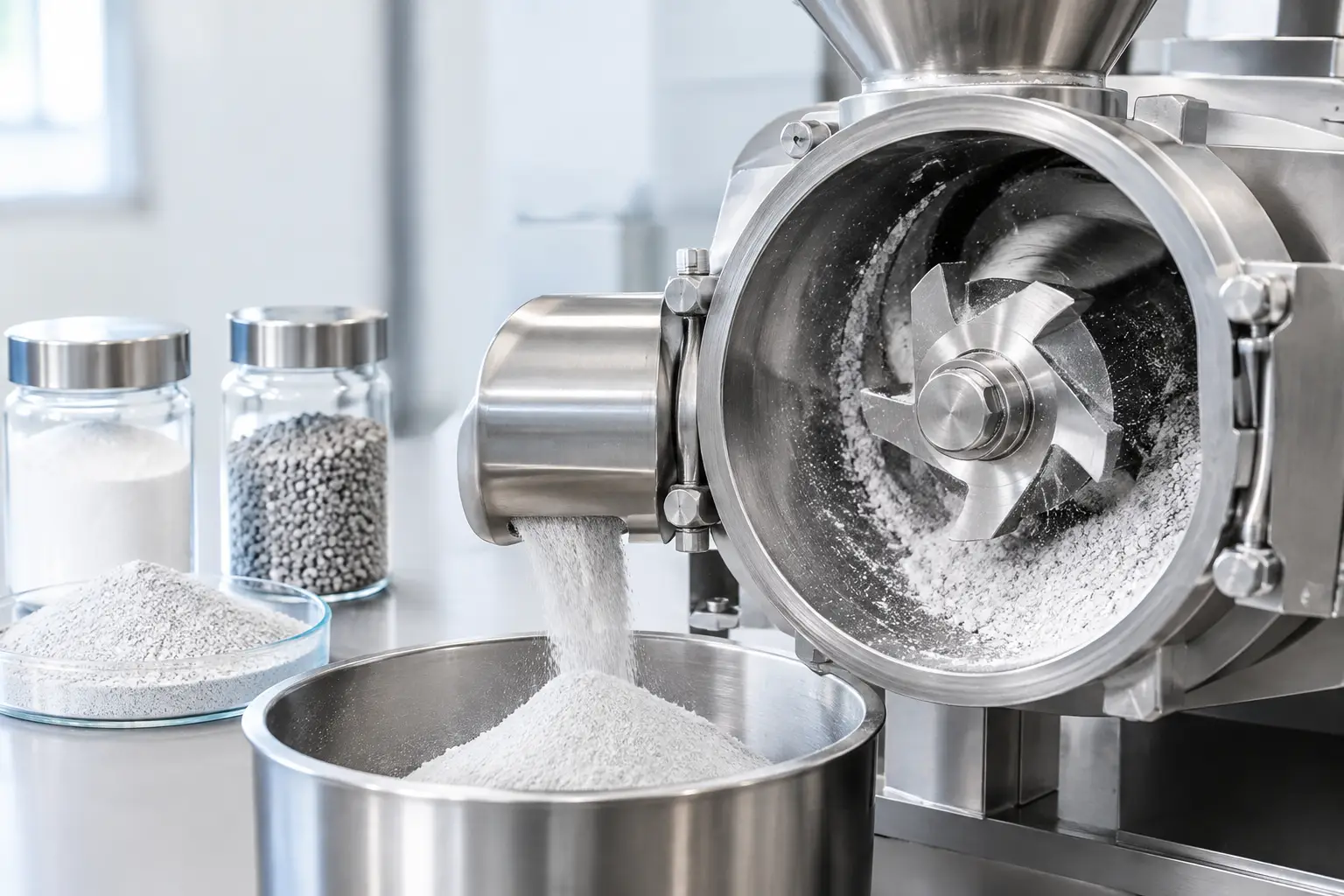
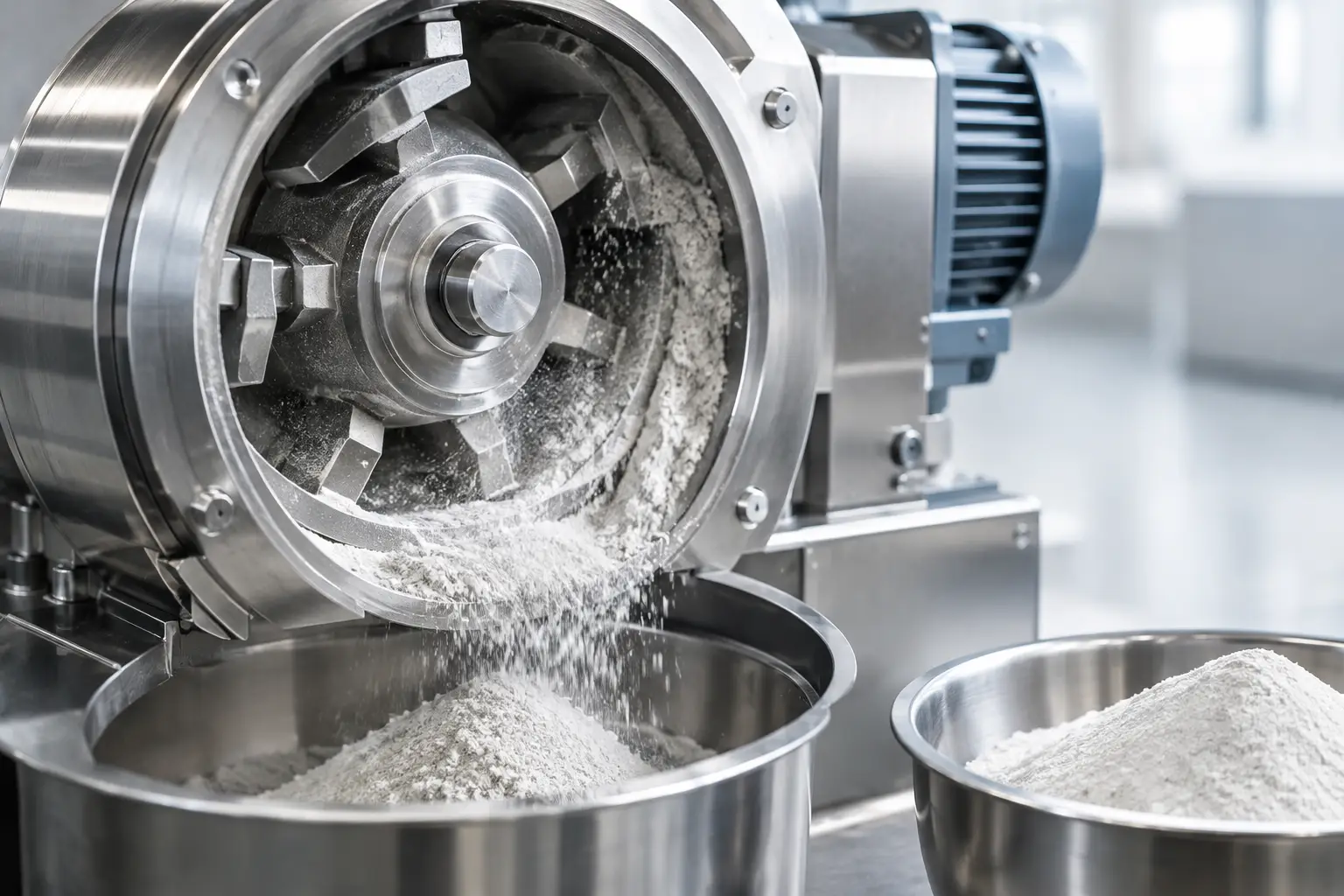
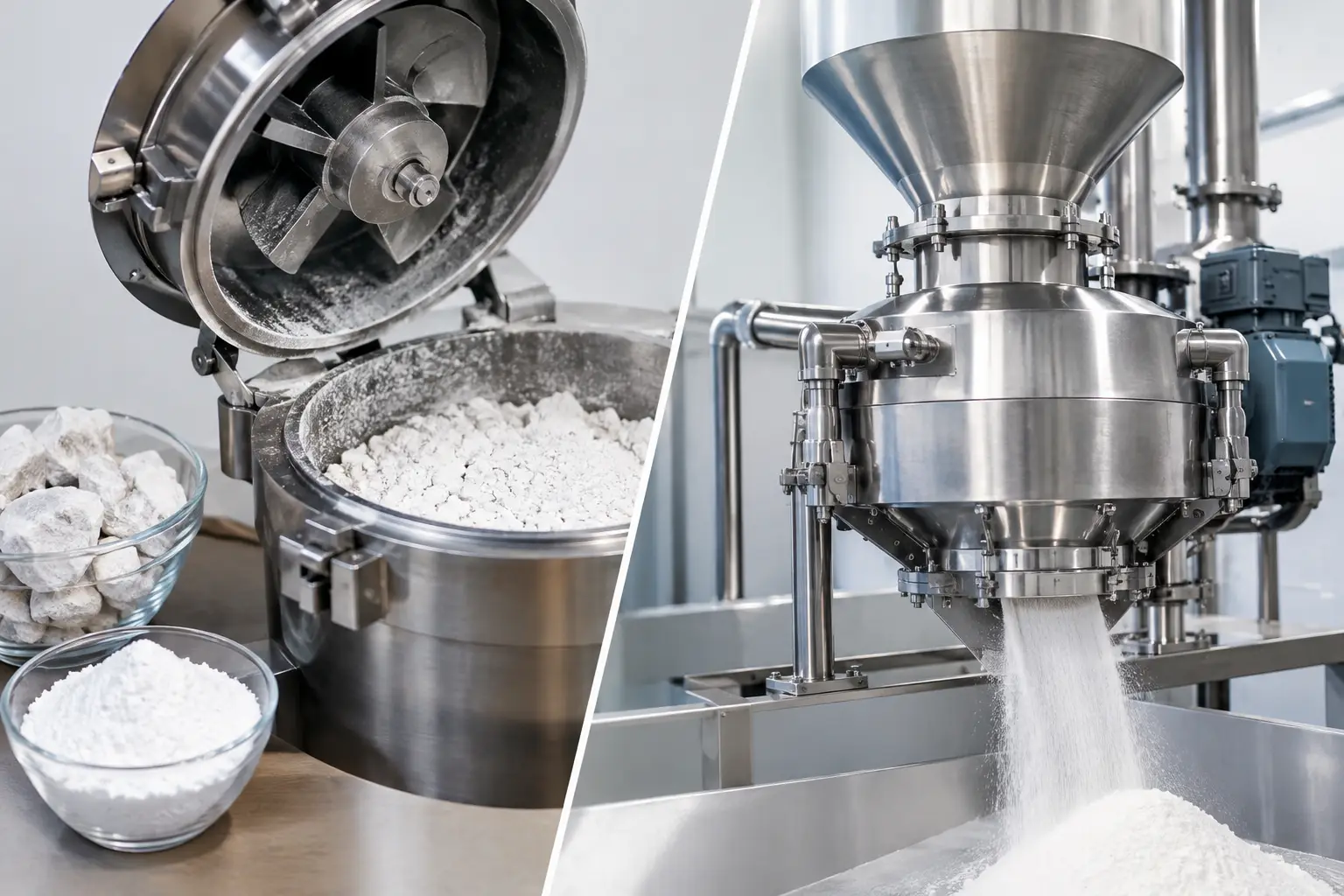
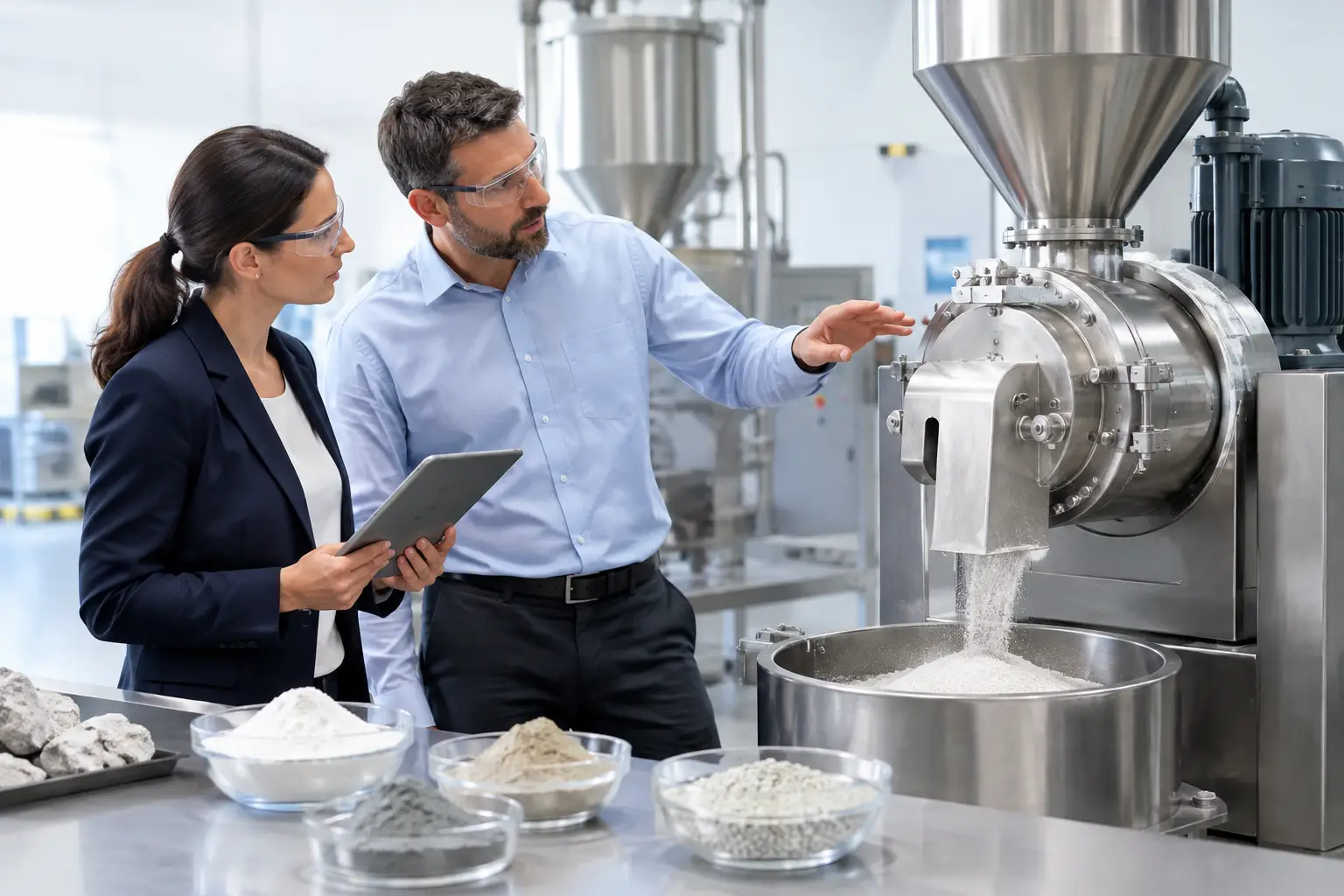
A hammer mill can appear to be a simple piece of size-reduction equipment until product quality drifts, throughput falls, or maintenance intervals shorten unexpectedly. To optimize hammer milling, manufacturers need to treat the mill as part of an operating system that includes material properties, feed presentation, airflow, discharge, and downstream requirements. Adjusting one variable without considering the others can improve one result while creating a new bottleneck elsewhere.
For production teams, the objective is not simply the finest possible grind. It is a repeatable particle-size distribution at the required capacity, with acceptable temperature rise, energy use, wear rate, and contamination risk. That balance depends on matching the hammer mill configuration and operating conditions to the material and the process around it.
Start With the Required Product Specification
Hammer milling performance should be measured against the finished product requirement, not against an arbitrary screen size. Define the target particle-size distribution, allowable oversize and fines, bulk-density expectation, moisture range, and acceptable product temperature before selecting operating settings.
A screen opening does not directly equal final particle size. Material can pass through a screen only after it has been reduced sufficiently and is presented to the screen at the right angle and velocity. Brittle materials may produce a relatively narrow distribution at a given screen size, while fibrous, elastic, or high-moisture materials may circulate longer in the chamber and create more fines, heat, or variability.
The downstream process also matters. For example, a material feeding a blender may tolerate a broader distribution than one entering tablet compression, extrusion, coating, or pneumatic conveying. In mineral and chemical applications, oversize may limit reaction performance or separation efficiency. In food and nutraceutical processing, excess fines can affect flow, dust generation, appearance, and batch uniformity.
Optimize Hammer Milling Through the Core Variables
The most effective improvements usually come from controlling a small set of interdependent variables rather than making a single aggressive change to rotor speed or screen size.
Select the screen for capacity and distribution
Screen selection governs residence time, discharge rate, and the upper end of the particle-size distribution. A smaller opening generally produces a finer product, but it also increases the likelihood of restricted discharge, elevated chamber temperature, higher energy draw, and lower throughput. It can be the right choice when the specification requires it, but it should not be used to compensate for poor feed preparation or an unsuitable milling method.
Screen open area is as important as hole diameter. A screen with insufficient open area may limit output even when its nominal opening is correct. The hole pattern, material thickness, and the tendency of a product to blind or smear must all be considered. Sticky or moisture-sensitive materials may require a screen design that resists buildup, along with controlled air movement and more frequent inspection.
Set rotor speed for material behavior
Tip speed determines impact energy. Higher speed can improve breakage of hard, brittle materials and reduce oversize, but it can also generate excess fines, heat, noise, and wear. Lower speed may preserve a more controlled distribution for friable materials, although capacity can suffer if the impact energy is no longer sufficient.
There is no universally correct rotor speed. A crystalline chemical, dried botanical, polymer, and battery precursor respond differently to impact. The practical approach is to establish a validated speed range through trials, then monitor motor load, product temperature, particle-size results, and throughput as part of the operating recipe.
Control feed rate and feed consistency
An inconsistent feed stream is a common reason for inconsistent milling results. Surges can overload the grinding chamber, reduce effective impact, and cause oversize material to exit or recirculate. Starved feeding can increase air-to-product ratio, extend residence time, and create unnecessary fines.
Use a feeder capable of delivering a stable mass flow appropriate for the material. The feeding system must account for bulk density, bridging tendency, particle shape, moisture, and segregation. Loss-in-weight feeding provides the highest degree of control where formulation accuracy or batch consistency is critical, while volumetric feeding may be adequate for stable, free-flowing materials.
Feed particle size also affects performance. Large agglomerates or variable upstream granules can create intermittent load spikes and unstable distribution. If the incoming material is outside the hammer mill’s practical feed range, a pre-breaker, delumper, or alternative primary size-reduction stage may improve overall system reliability.
Manage airflow and discharge
Airflow removes product from the milling zone, transports fines, and influences temperature. Too little airflow can allow material to remain in the chamber longer than intended, increasing heat exposure and overgrinding. Too much airflow may pull light particles through too quickly, reduce classification control, or overload downstream collection equipment.
The discharge path must be sized for the actual production rate. Restricted ducting, an undersized cyclone, a loaded filter, or poor rotary-valve performance can create backpressure that directly affects the hammer mill. This is why mill optimization should include pressure readings, collector differential pressure, airflow verification, and inspection of transfer lines.
For temperature-sensitive materials, airflow can help, but it is not always enough. Cooling the inlet air, conditioning the feed, or using cryogenic grinding may be more appropriate when heat causes melting, oil release, flavor loss, degradation, or handling problems. A hammer mill is highly effective for many materials, but it is not the optimal technology for every fine or heat-sensitive application.
Maintain Impact Efficiency and Product Integrity
Hammers, screens, liners, and rotor components are process-critical wear parts. As hammers wear, their effective geometry changes and impact efficiency declines. Worn edges can increase recirculation, broaden the particle-size distribution, and reduce throughput before an operator sees an obvious mechanical failure.
Establish inspection intervals based on run hours, material abrasiveness, and measured performance trends. Rotor balance must be checked whenever hammers are replaced or reversed. Uneven wear or mismatched components can introduce vibration, bearing stress, and safety concerns. For abrasive minerals, pigments, and advanced materials, wear-resistant construction may reduce downtime, but the selected metallurgy must also meet product contamination requirements.
Contamination control extends beyond material selection. Evaluate the full product-contact path, including the feed hopper, magnets, screen retention arrangement, seals, discharge transition, and collection equipment. Pharmaceutical, food, nutraceutical, and battery-material applications may require specific finishes, cleanability, access design, and validation procedures. The lowest maintenance cost is not always the lowest operating cost if it compromises product integrity or sanitation time.
Use Process Data to Hold the Operating Window
A stable hammer milling process is managed with operating limits, not operator intuition alone. Document the approved screen, hammer configuration, rotor speed, feed rate, airflow setting, product temperature limit, and motor-load range for each product. When results move outside the range, the team can investigate a defined set of causes instead of making random adjustments.
Track particle-size distribution alongside throughput. Throughput alone can hide quality drift, while particle-size testing alone can overlook a growing restriction in the system. Motor amperage, vibration, bearing temperature, collector differential pressure, and product discharge temperature provide useful early indicators of developing problems.
For demanding applications, pilot trials are often the fastest route to a defensible production design. They allow engineers to compare screen options, speed ranges, and feed conditions using the actual material rather than assumptions based on a similar product. The resulting data can guide scale-up, define utility requirements, and identify whether integrated classification, cooling, containment, or automated feeding is needed.
When a Hammer Mill Needs a Different Process Partner
Hammer mills are versatile, high-throughput machines for many dry materials, particularly where moderate-to-fine reduction and durable operation are required. However, some targets call for a different or combined technology. Very tight fine-particle specifications may favor an air classifier mill or jet mill. Materials that soften under impact may benefit from cryogenic processing. Products requiring highly uniform granulation may need controlled preconditioning or screening before and after milling.
The right question is not whether a hammer mill can achieve a result during a short test. It is whether it can hold that result over extended production runs at the required capacity, cleanliness level, and cost per pound. DP Mills evaluates these operating realities when engineering milling systems around actual material behavior and plant requirements.
A well-optimized hammer mill runs within a defined process window, not at its mechanical limit. When screen design, rotor energy, feed control, airflow, and maintenance practices work together, the result is more predictable particle sizing, steadier production, and a process that is easier to scale with confidence.