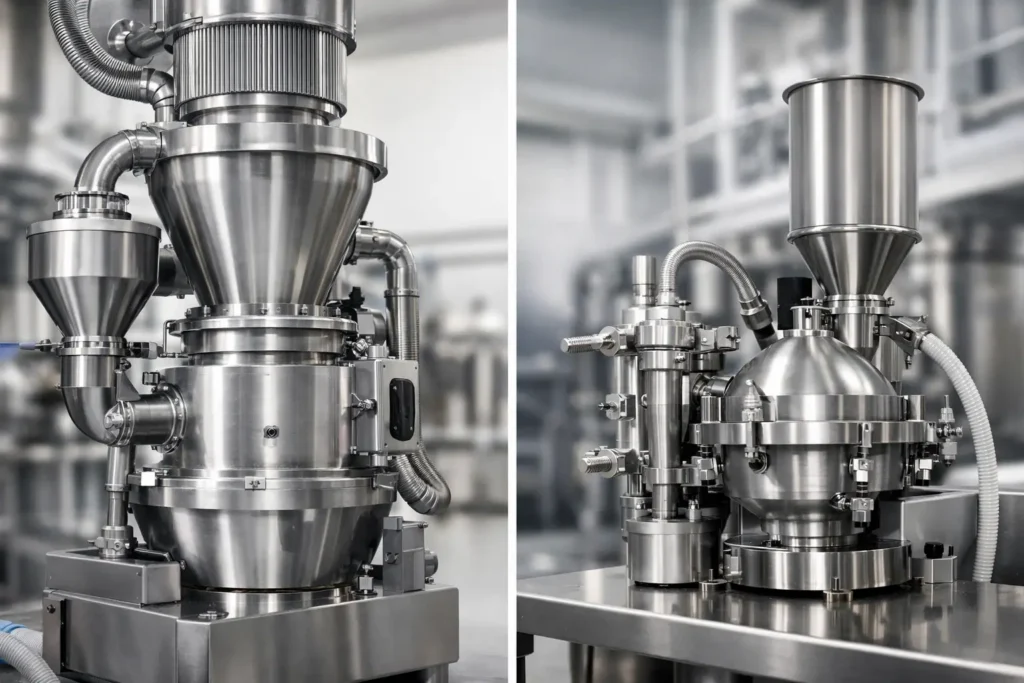
When a production line is missing its particle size target, the problem is rarely just the mill. It is usually the interaction between material behavior, throughput demands, heat sensitivity, contamination limits, and the fineness the process actually needs. That is why the air classifier mill vs jet mill question matters so much in real manufacturing environments. Both technologies can produce fine powders, but they do it in very different ways, and those differences directly affect yield, consistency, operating cost, and downstream performance.
Air classifier mill vs jet mill: the core difference
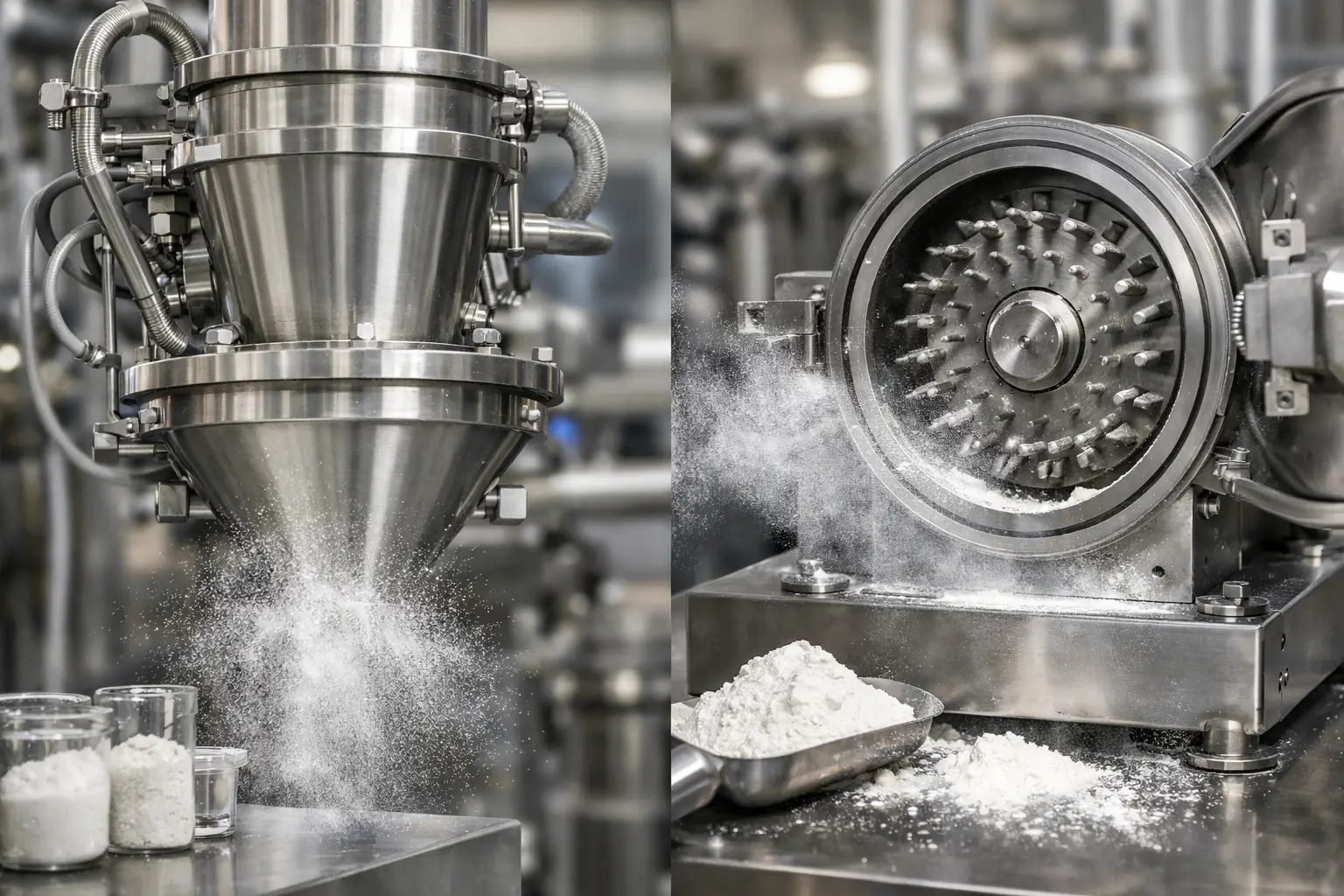
An air classifier mill uses mechanical impact grinding combined with internal air classification. Material enters the grinding zone, particles are reduced by rotating elements, and an integrated classifier separates acceptable particles from oversize material. Fine particles pass through, while larger particles remain in the milling chamber until they are reduced further.
A jet mill works without internal mechanical grinding media. Instead, high-velocity compressed air or gas accelerates particles so they collide with each other. Size reduction occurs through particle-to-particle impact, and an internal classifier or system design controls the final cut point.
That distinction matters because it shapes nearly every performance characteristic. Air classifier mills generally offer strong throughput and efficient fine grinding in a compact footprint. Jet mills are often selected when the process demands very fine particle sizes, tighter contamination control, or lower mechanical heat input. Neither is universally better. The right choice depends on the material and the production target.
How each mill affects particle size control
For many operations, particle size control is the first screening criterion. An air classifier mill can produce a controlled top size and a relatively narrow distribution, especially when the classifier speed and rotor configuration are matched to the material. This makes it a strong option for applications where a defined fine powder is required but not necessarily in the ultrafine range.
Jet mills typically move further into the fine and ultrafine spectrum. They are often chosen when the target particle size drops to micron or sub-10-micron levels and when excessive coarse particles cannot be tolerated. Because the grinding mechanism relies on particle collisions rather than direct mechanical contact, jet milling can support extremely fine reduction with less risk of certain wear-related effects.
That said, the achievable result still depends on feed uniformity, moisture, density, hardness, and how the material fractures. A brittle chemical powder and a fibrous botanical ingredient will not respond the same way in either system. This is where application testing becomes more valuable than spec-sheet comparisons.
When tighter top size matters more than average size
Many manufacturers focus on average particle size and overlook the importance of top size control. In coatings, pharma, battery materials, and certain mineral applications, a small population of oversize particles can create major downstream issues. An integrated classifier in an air classifier mill can provide dependable top cut control for a wide range of products, but if the specification pushes into very fine territory with minimal oversize tolerance, a jet mill may provide a better path.
Throughput, efficiency, and cost of operation
Throughput is often where the practical differences become clearer. Air classifier mills are commonly favored when production rates matter and the target size remains within the mill’s efficient operating range. Their mechanical action can deliver strong capacity, making them attractive for continuous industrial processing where both fineness and productivity are important.
Jet mills, while highly effective for fine size reduction, generally rely on compressed air or gas as a major energy input. That can increase operating cost compared with mechanical milling systems, especially in high-volume applications. If a product does not require ultrafine performance, using a jet mill can add cost without delivering meaningful process value.
This is one of the most common selection mistakes. A manufacturer may assume the finest technology is automatically the best technology. In practice, over-specifying the mill can reduce efficiency and raise utility costs. If the process only needs a controlled fine powder at commercially efficient rates, an air classifier mill may be the better long-term fit.
Heat generation and material sensitivity
Heat-sensitive materials deserve careful evaluation in any air classifier mill vs jet mill decision. Mechanical impact mills can generate heat during size reduction, although system design, airflow, rotor speed, and residence time all influence the actual temperature rise. For many materials, this is manageable. For products prone to melting, smearing, softening, or degradation, it becomes a more serious factor.
Jet mills are often selected for heat-sensitive applications because the expansion of compressed gas can help offset temperature rise during grinding. They can be a strong choice for certain pharmaceuticals, specialty chemicals, and advanced materials where thermal exposure must be minimized.
Still, heat sensitivity is not a simple yes-or-no filter. Some products that are moderately heat sensitive can run successfully in an air classifier mill with the right engineering controls. Others may require jet milling or even cryogenic processing. The material’s softening point, feed temperature, stickiness, and required throughput all affect the answer.
Contamination, wear, and product purity
Contamination control is another major decision point. Because an air classifier mill uses mechanical grinding components, wear surfaces must be selected appropriately for the product. In many industrial applications, this is addressed through proper material-of-construction choices, wear protection, and sanitary or specialized system design.
Jet mills are often preferred for high-purity applications because there are fewer mechanical contacts in the grinding process itself. For products where trace metal contamination is tightly limited, this can be a meaningful advantage. Pharmaceutical ingredients, electronic materials, specialty minerals, and battery powders are common examples where wear contamination becomes part of the mill selection process.
However, product purity is never determined by the mill alone. Feed systems, classifiers, valves, collection equipment, and overall system integration also influence contamination risk. A well-engineered milling system is what protects product integrity, not just the base machine type.
Material behavior changes the answer
The most useful way to compare these technologies is not by asking which mill is better, but by asking how the material behaves under stress. Brittle materials often respond well to both systems, depending on the target size. Hard abrasive products may push the conversation toward wear management and system durability. Sticky, oily, or fibrous materials may challenge both technologies in different ways.
Air classifier mills are often well suited for materials that need controlled fine grinding with efficient classification and practical production throughput. Jet mills are often better suited for applications requiring very fine particle sizes, reduced contamination risk, or lower thermal impact.
In food and nutraceutical processing, for example, the answer may depend on fat content, temperature sensitivity, and sanitation requirements. In chemicals, flowability, hardness, and PSD targets tend to drive the decision. In battery and advanced materials, contamination, top size control, and repeatability often carry more weight than raw throughput alone.
Choosing the right system for production, not just the lab
A lab result can be misleading if it does not scale well. Some materials achieve excellent fineness in a small jet mill test, but the operating economics may not support full production volumes. In other cases, an air classifier mill may meet the particle size target at a lower total cost while offering easier integration into an existing line.
That is why equipment selection should account for the full process window. Feed rate stability, dust handling, inerting requirements, explosion protection, cleanability, maintenance access, and system controls all affect real production performance. The mill is only one part of a larger engineered solution.
For manufacturers evaluating new equipment, the most effective approach is to define the real process priorities in order. Is the main issue tighter particle distribution, lower contamination, higher throughput, lower energy use, better scalability, or less thermal stress? Once those priorities are clear, the right technology becomes easier to identify.
Air classifier mill vs jet mill: which should you choose?
If your operation needs fine grinding with strong throughput, reliable top size control, and efficient production performance, an air classifier mill is often the more practical solution. It can deliver excellent results across a wide range of industrial materials while supporting scalable output and controlled particle size.
If your process requires ultrafine particles, lower mechanical heat impact, or stricter contamination control, a jet mill may be the better fit. It is especially valuable when the specification is tight enough that conventional impact-based fine grinding starts to lose efficiency or consistency.
The right decision usually comes down to where the process can tolerate compromise. If utility cost is a concern, compressed air demand matters. If purity is critical, wear surfaces matter. If output drives profitability, throughput matters. And if the product behaves differently from one batch to the next, application expertise matters most of all.
The best milling system is the one that performs reliably under your actual production conditions, not just the one that sounds more advanced on paper. A well-matched process solution should make the rest of the operation easier, from feeding and classification to collection, packaging, and quality control. That is where sound engineering delivers real value long after the equipment is installed.