Organophilic Lignite for Oil-Based Muds: Science, Quality Levers, and Field Performance
What is Organophilic Lignite
Organophilic lignite (OL) is a foundational additive in oil-based and synthetic-based drilling fluids. Beyond “make lignite oil-wet,” OL is a surface-chemistry and particle-engineering problem: convert a heterogeneous, oxygen-rich macromolecular solid into a reproducible, oil-dispersible powder that stabilizes rheology and controls filtrate over wide downhole conditions. This white paper explains what makes lignite organophilic, why particle size and moisture control dominate performance, and how to measure “good” OL using lab tests that correlate to the field. Emphasis is placed on mechanisms, measurement, and decision frameworks rather than equipment lists.
1) What “Organophilic” Really Means
Organophilicity is the tendency of a surface to prefer nonpolar (oil) phases over water. Raw lignite—a humic-rich, low-rank coal—contains aromatic clusters with oxygenated groups (carboxyl, phenolic, carbonyl). Untreated, its surface is partially hydrophilic. Organophilic treatment replaces or masks hydrophilic sites with long-chain cations (e.g., quaternary ammonium) or amines that:
- Reduce surface free energy with respect to base oils,
- Provide steric barriers to re-agglomeration, and
- Improve wetting and dispersion into OBM.
Key takeaway: OL isn’t simply “coated” lignite; it’s a tuned surface-energy system that changes how particles interact with oil, brine, and other solids under shear, pressure, and temperature.
2) From Molecules to Mud: Mechanisms That Matter
- Adsorption & ion exchange: Long-chain cationic species associate with negatively charged or polar sites, orienting hydrocarbon tails outward.
- Wetting and dispersion: Lower contact angle in oil phases and reduced inter-particle attraction help the powder pass screen tests and build rheology predictably.
- Thermal endurance: Aromatic/heteroatom content and the stability of the organophilic layer influence high-temperature rheology and HP/HT filtrate.
Practical implication: The chemistry–process–structure triangle rules performance. The same dosage can behave differently if moisture, PSD, or treatment temperature drift.
3) Particle Engineering: Why PSD and Moisture Dominate
- PSD (particle size distribution): A tight top-cut (e.g., D90 ≤ 75–90 µm) limits settling and dosing variability. Too coarse → slow wet-out; too fine → excessive viscosity, dust, and handling issues.
- Moisture: Residual water (commonly targeted ≤2–4 %) competes with organophilic species for surface sites and can hinder dispersion.
- Bulk density & flow: Conditioning (bin aging, air pads) improves pack consistency and feeder stability, reducing blend-to-blend drift in plant or mud plant operations.
Field lens: Mud engineers feel PSD and moisture as “how fast it disappears into oil” and “how stable the rheology stays from rig-up to TD.”
4) Choosing Treatment Chemistry (Without Brand Names)
- Quaternary ammonium compounds (quats): Robust cationic head, long alkyl chains; strong, temperature-tolerant organophilicity.
- Primary/secondary amines: Effective at lower cost; sometimes more sensitive to moisture or odor.
- Loadings: Often 3–10 wt% of active on lignite, tuned by application tests (screen dispersion, rheology curves).
- Sustainability trends: Push toward solvent-free processing, lower VOCs, and exploration of bio-derived long-chain cations where practical.
Decision logic: Start with target mud behavior (PV/YV/ESD and HP/HT filtrate), back-calculate chemistry and loading, then lock with pilot tests.
5) Measuring “Good” Organophilic Lignite
An educational toolkit that correlates to field performance:
- Screen dispersion test (in base oil): Time and residue after passing through a specified mesh (e.g., 120-mesh). Quick diagnostic of wetting and de-agglomeration.
- Rheology profiling: Plastics viscosity (PV), yield value (YV), and gel strengths in representative OBM (base oil + emulsifier + lime + brine as spec’d). Track at ambient and elevated temperatures to mimic downhole.
- HP/HT fluid loss: Measures filtrate control contribution, especially relevant when OL is paired with fluid-loss packages.
- PSD by laser diffraction: Report D10/D50/D90; monitor lot drift.
- Residual moisture: Infrared or LOD methods; trend vs rheology reproducibility.
- Organic nitrogen/amine content: Titration or TN (Kjeldahl) as a proxy for treatment level (correlate to performance, don’t over-interpret in isolation).
- Bulk density & flow index: For dosing reproducibility at rig sites.
Lesson: No single metric “defines” OL. Build a multivariate fingerprint: PSD + moisture + amine level + dispersion + rheology + HP/HT.
6) How OL Works in OBM Systems
- Rheology shaping: OL contributes to low-shear yield and suspension while keeping PV manageable when correctly sized and treated.
- Thermal stability: Properly treated lignite resists viscosity collapse at temperature and supports emulsion stability.
- Synergy: OL complements organoclays (primary yield builders) and asphaltites/resins (fluid loss/HT stabilizers). Balancing packages avoids over-shearing or excessive gels.
Educational nuance: Treat OL like a tunable rheology modifier, not a commodity filler. Package design beats single-additive optimization.
7) Common Failure Modes (and What They Teach)
- Slow wet-out / fish-eyes: Usually coarse PSD or high moisture; can also be under-treated surfaces.
- Over-viscosity: Excess fines or overdosing OL in a clay-rich mud.
- Batch-to-batch drift: Uncontrolled feed variability or temperature/moisture variation during treatment.
- Odor/VOC complaints: Amines or solvent carryover; indicates need for capture or solvent-free processing.
Moral: Most “bad OL” stories trace back to PSD + moisture + treatment uniformity—not exotic chemistry.
8) EHS and Sustainability—An Educational View
- Combustible dust: Lignite fines are combustible; housekeeping, explosion venting/ isolation, and bonding/grounding are not optional.
- Exposure control: Quats/amines require closed transfer, local capture, and PPE; odor management protects worker comfort and community relations.
- VOC minimization: Solvent-free processes reduce permitting burden; if solvents are used, engineered recovery loops and carbon polishing are standard practice.
- Material stewardship: Consistent product reduces overdosing at rigs, lowering total chemical intensity per well—an overlooked sustainability lever.
9) Economics Without the Hype
- What you actually pay for: Tight PSD control, moisture management, and reproducible treatment—because they deliver predictable mud behavior and fewer nonproductive events.
- Hidden costs: Dust losses, caking, and rework at mud plants; inconsistent lots that force rig-site troubleshooting.
- Smart spend: Invest in characterization (PSD, moisture, rheology correlations) and supplier process control. These return more than glamorous equipment labels.
10) Future Directions
- Bio-based cationics: Interest is growing, but scale and robustness at HP/HT remain the gating factors.
- Model-based QC: Linking mixer power/temperature histories to final rheology reduces lab burden and catches drift earlier.
- Application-specific PSDs: Differentiated OL grades for high-angle wells vs deep HP/HT, tuned for dispersion rate and sag resistance.
How DP Pulverizers Serves Organophilic Lignite — From Particle Engineering to Plant Reliability
Where Milling Sits in the OL Value Chain
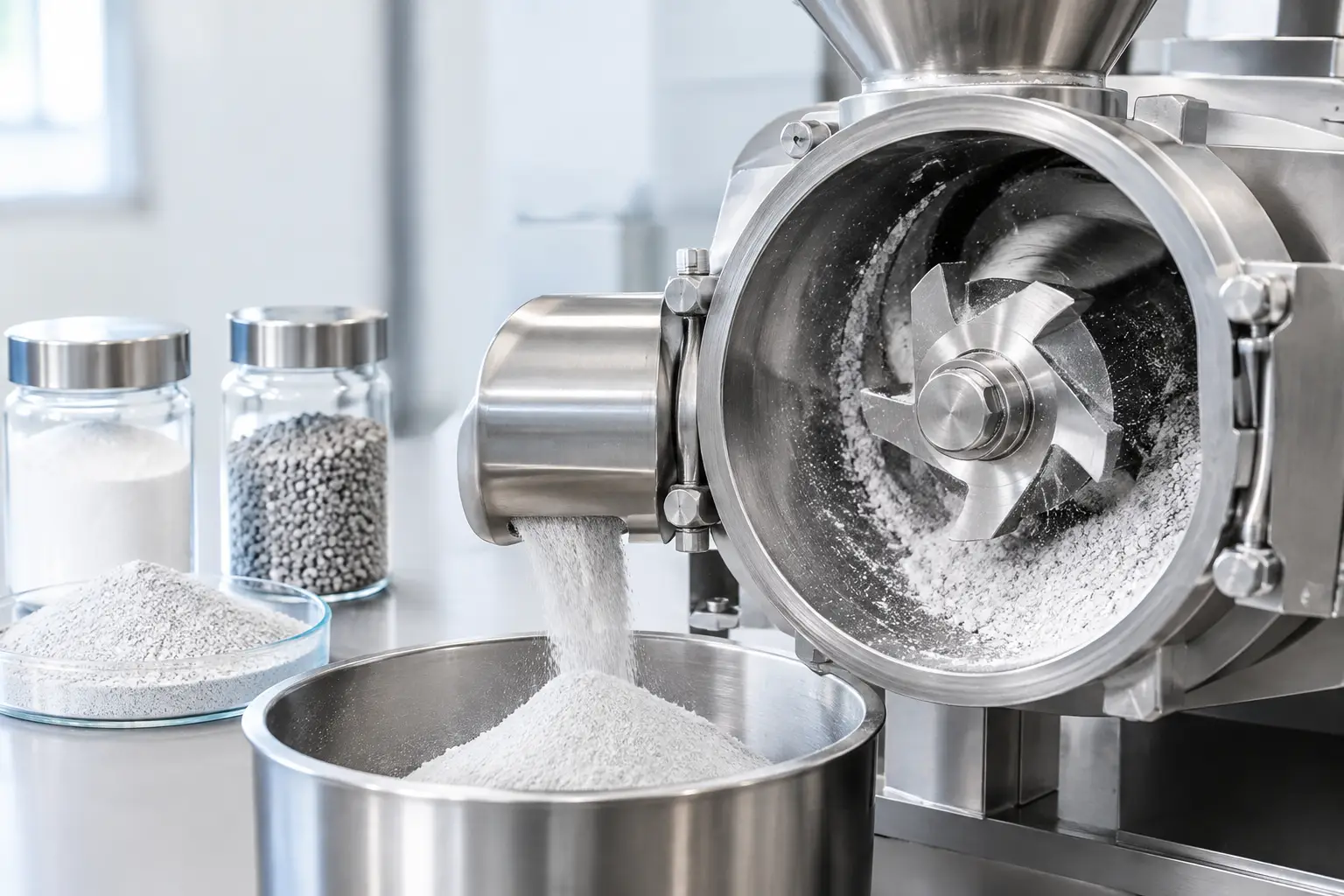
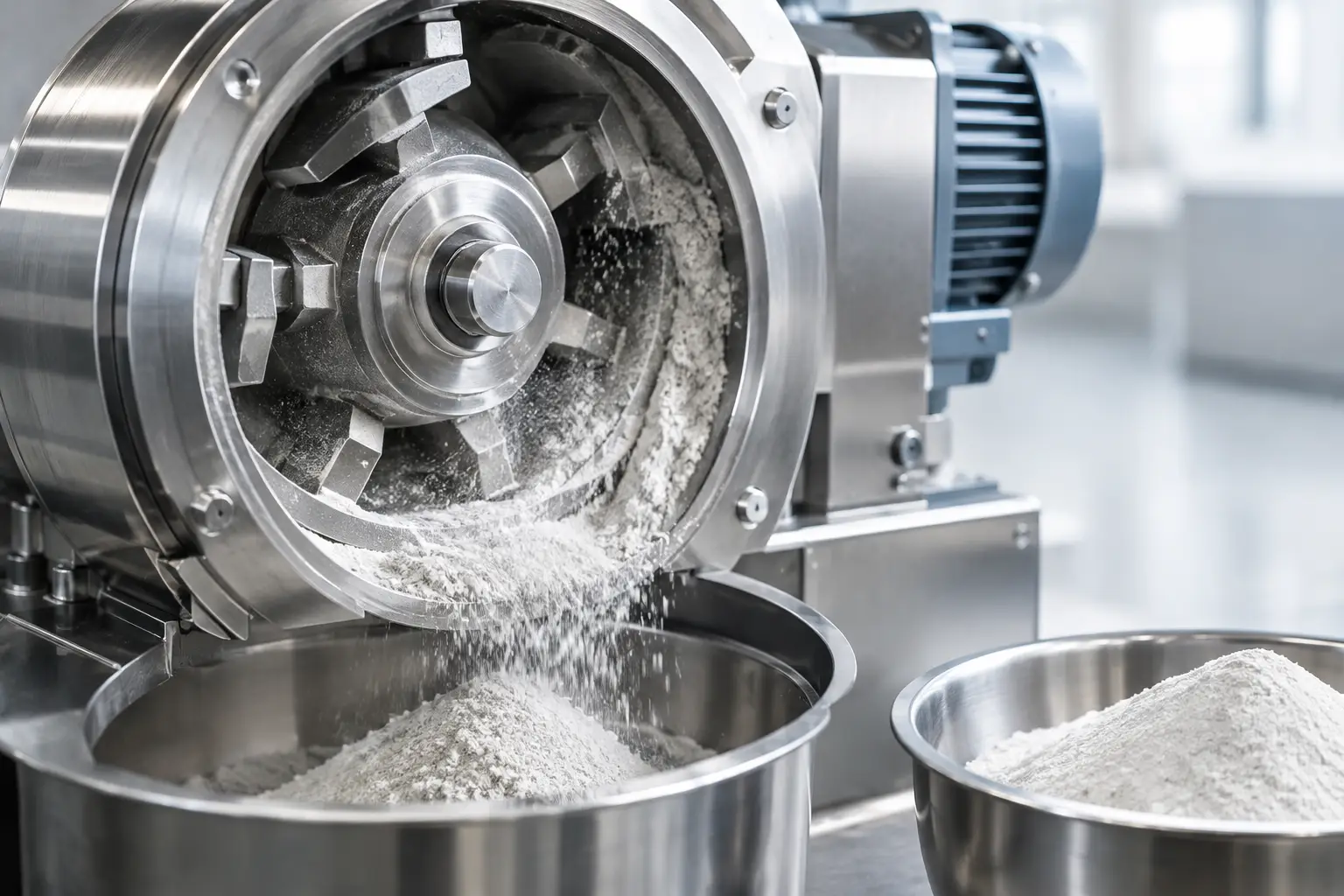
In organophilic lignite (OL), milling is not a vanity step; it’s particle engineering that sets dispersion speed, rheology stability, and dosing predictability. The grinder you choose determines the top-cut (D90), fines fraction, and shape—all of which control how quickly OL “disappears” into oil and how it behaves from rig-up to TD.
Typical OL targets: D90 ≤ 75–90 µm, tight top-cut, limited ultra-fines; moisture ≤2–4% at treatment and pack.
DP Pulverizers — Application Fit at a Glance
- Primary sizing / pre-grind: Heavy-duty hammer mill or single-pass crusher to feed mills with a stable 5–25 mm stream.
- Main grinding & classification (the workhorse): Air Classifying Mill (ACM) or Pin/Turbo Mill with internal classifier to hit D90 75–90 µm with a sharp cut.
- Curve shaving / finishing: Secondary safety screen or light re-mill to knock out stragglers and soft agglomerates.
- Special cases: Jet mill only if you truly need very fine, contamination-free product—usually overkill for OL.
Why the ACM is usually king for OL: Closed-loop control over classifier tip speed and process airflow gives you repeatable D90 without manufacturing a beach of fines.
Mill Selection Guide (Educational, Not Salesy)
- Best for: Tight D90 60–120 µm with a sharp top-cut; minimal screen wear; continuous operation.
- Levers you control: Classifier RPM (cut size), process airflow (loading & residence), mill RPM (impact intensity).
- Why it helps OL: Fast wet-out in base oil with fewer “floaters,” reduced rig-site dose variability.
Pin / Turbo Mill (with external or internal classification)
- Best for: Robust, lower-maintenance operations; good when your customers tolerate a slightly fatter top-end.
- Levers: Rotor speed, pin configuration, external classifier or downstream screen.
- Why it helps OL: Cost-effective curve for D90 ~90–120 µm; resilient to feed swings.
Hammer Mill (pre-grind)
- Best for: Taming feed heterogeneity; feeding dryers and ACMs with consistent PSD.
- Levers: Screen aperture, tip speed.
- Why it helps OL: Protects the “precision” mill from surges and tramp.
Jet Mill (rare for OL)
- Best for: Sub-50 µm, contamination-sensitive materials; inert milling.
- Why it’s seldom used for OL: Energy hungry and too fine; you’ll overshoot rheology targets and dust handling gets spicy.
Performance Levers DP Designs Around
- Top-cut sharpness: Internal classifier geometry and wheel control give consistent D90. This directly governs dispersion speed and mud stability.
- Fines management: Process airflow and rotor design minimize gratuitous fines that spike PV and dust.
- Thermal management: Proper sweep air and heat extraction protect surface chemistry prior to organophilic treatment.
- Wear & contamination control: Options in Hardox/AR, stainless, or ceramic-lined zones where product purity or corrosion matters.
- Uptime: Tool-less access where possible, split housings, and designed-in maintenance windows reduce the “hidden OPEX” of cleaning and screen changes.
Safety & Compliance (Non-Negotiables for Lignite Dust)
- Combustible dust engineering: Explosion venting, isolation valves, and back-blast protection on mills, cyclones, and collectors.
- Grounding/bonding across the system; anti-static flexible connectors.
- Class II/ATEX dust collection sized for your real dust load, not wishful thinking.
- Optional inerting: Nitrogen purges or O₂ monitoring for specific EHS policies—typically not required for OL if housekeeping is disciplined.
Integrated Systems That Make Plants Behave
- Mill + classifier + cyclones/filter receiver sized as a unit (air balance first, steel second).
- Central or point-of-use dust collection with pulse-jet sequencing tuned to the actual loading—because blinded bags are stealth downtime.
- Smart feeders (loss-in-weight or VFD screws) to keep the mill at optimal loading; surge bins with level control to de-couple upstream dryer swings.
- PLC/HMI recipe control: lock classifier RPM, blower frequency, feed rate, and temperature bands; historians for PSD drift troubleshooting.
- Pack-out thinking: Proper product conditioning (bin aging, air pads) so your valve-bag packer or FIBC filler hits weight without rework.
Pilot-to-Plant Pathway
- Bench & pilot grinding: Establish the PSD–rheology curve (D90 vs dispersion rate vs PV/YV) in your representative base oil—not just water.
- Transfer rules: Hold classifier wheel tip-speed and air-to-solids ratios; validate on a 1–2 t/h pilot ACM before buying 10 t/h steel.
- QC fingerprint: PSD (D10/D50/D90), moisture, bulk density, screen dispersion, rheology at ambient and elevated temperature.
Typical 10 t/h Numbers (Order-of-Magnitude)
- Main mill motor: 110–250 kW depending on cut-size and feed hardness.
- Classifier motor: 7.5–30 kW with VFD control.
- System airflow: 8,000–18,000 m³/h (4,700–10,600 cfm) through the circuit—set by dust load and cut-size.
- Collector: Appropriately vented/pulsed; filtration velocity ≤ 1.0–1.5 m/min for long bag life.
- Maintenance cadence: Weekly inspections, bag leak checks, classifier bearings on a predictive schedule.
Quality-by-Design (Data Your Customers Care About)
DP-style systems make it easy to prove consistency:
- Automatic lot logs of classifier RPM, blower Hz, mill amps, product temp.
- Inline moisture checks at dryer discharge; alarms before the mill sees wet slugs.
- PSD spot checks tied to a control chart; alarms when D90 creeps toward spec fences.
- COA automation: Pull lab values into the historian and publish with batch metadata.