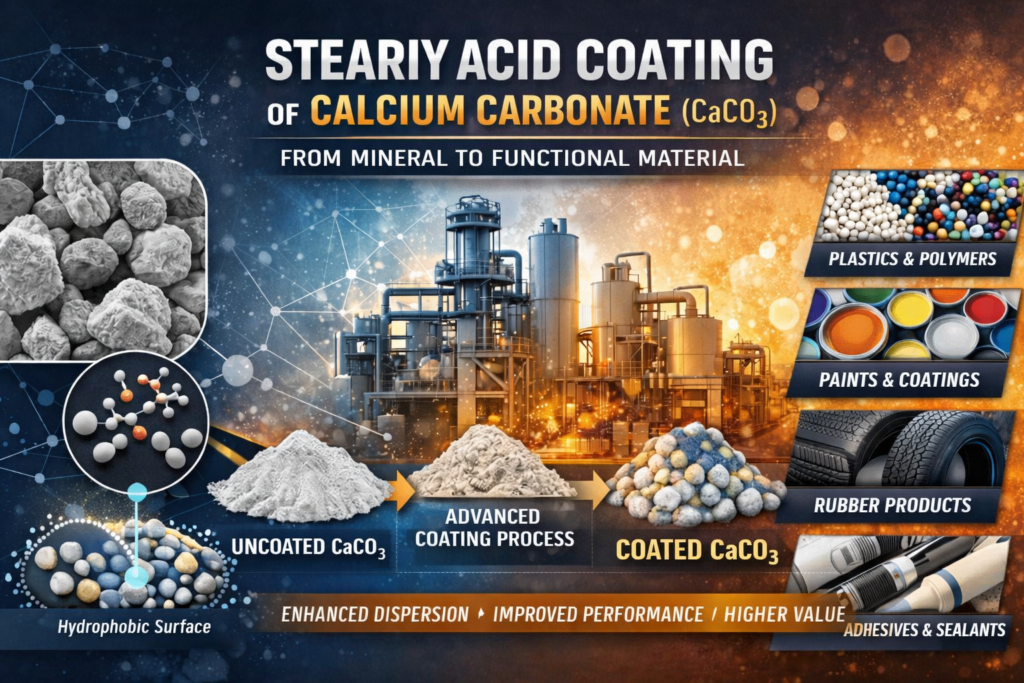
Stearic Acid Coating of Calcium Carbonate (CaCO₃): The Complete Industrial Guide to Surface Engineering in Mineral Processing
In modern manufacturing, the difference between a commodity and a premium material is no longer just particle size—it is surface functionality.
Calcium carbonate (CaCO₃) is one of the most widely used minerals in the world. It is abundant, cost-effective, and versatile. However, in its natural state, CaCO₃ is inherently hydrophilic, limiting its compatibility with organic systems such as polymers, coatings, and adhesives.
Through stearic acid surface modification, manufacturers transform CaCO₃ into a hydrophobic, high-performance functional filler—unlocking superior dispersion, improved processability, and enhanced end-product performance.
This is where mineral processing evolves into surface engineering.
Global Industry Overview: Where Stearic Acid Coated CaCO₃ Is Used
The demand for coated calcium carbonate is massive and continues to grow globally, driven by industries seeking cost optimization, performance enhancement, and material consistency.
1. Plastics & Polymer Compounding (Largest Market)
This is the dominant application for coated CaCO₃.
Used in:
- Polypropylene (PP)
- Polyethylene (PE)
- PVC (rigid and flexible)
- Engineering plastics
Why coating matters:
- Eliminates moisture attraction
- Improves dispersion in polymer matrices
- Reduces melt viscosity
- Enables higher filler loading (cost reduction)
Real-world impact:
- Pipe manufacturers increase filler loading while maintaining strength
- Film producers improve surface smoothness and process stability
- Masterbatch producers achieve consistent dispersion and color uniformity
2. Masterbatch Manufacturing
Coated CaCO₃ is a core ingredient in filler masterbatch production.
Benefits:
- High loading capacity (up to 80%+)
- Improved extrusion stability
- Reduced die build-up
- Consistent pellet quality
Key insight:
Masterbatch producers do not just buy CaCO₃—they buy coating quality and consistency.
3. Paints & Coatings Industry
Surface-treated CaCO₃ plays a critical role in both decorative and industrial coatings.
Functions:
- Extender pigment
- Rheology modifier
- Cost reducer without sacrificing performance
Coating advantages:
- Better compatibility with binders
- Improved gloss and surface finish
- Enhanced weather resistance
4. Rubber Industry
Used in:
- Tires
- Seals
- Industrial rubber components
Benefits:
- Improved dispersion in rubber compounds
- Enhanced mechanical properties
- Better processing behavior
5. Adhesives & Sealants
- Improves bonding characteristics
- Enhances stability in formulations
- Prevents moisture-related defects
6. Construction Materials
- Sealants
- Caulks
- Engineered building materials
Coated CaCO₃ ensures:
- Long-term stability
- Improved workability
- Reduced formulation costs
7. Advanced & Emerging Applications
- Bioplastics
- Specialty coatings
- High-performance composites
- 3D printing materials
- Wire & cable insulation compounds
The Science Behind the Process
At its core, stearic acid coating is a surface chemistry reaction, not simply a mechanical blending process.
Molecular Interaction:
- The carboxylic group (–COOH) of stearic acid chemically bonds to calcium ions on the CaCO₃ surface
- The hydrocarbon tail (C18 chain) forms a non-polar outer layer
Result:
- Hydrophobic particle surface
- Reduced surface energy
- Improved compatibility with organic systems
Critical Insight:
A successful coating process creates a uniform monomolecular layer, not a thick coating or partial coverage.
The Industrial Process: Engineering the Perfect Coating
1. Particle Preparation
- Target size: typically 5–50 microns
- Narrow particle size distribution improves coating uniformity
- Moisture must be tightly controlled (<0.2–0.3%)
2. Thermal Activation
- Powder heated to 100–130°C
- Ensures proper surface activation and coating adhesion
Engineering Challenge:
Maintaining uniform temperature across the entire powder mass is critical.
3. Stearic Acid Delivery
- Typical dosage: 0.8% – 2.0%
- Delivered as molten liquid or fine powder
Advanced systems use:
- Atomized spray injection
- Metered dosing systems
- Inline dispersion prior to injection
4. High-Intensity Coating Zone
This is the defining stage of the process.
Mechanisms involved:
- Shear forces
- Particle collisions
- Thermal energy distribution
- Controlled residence time
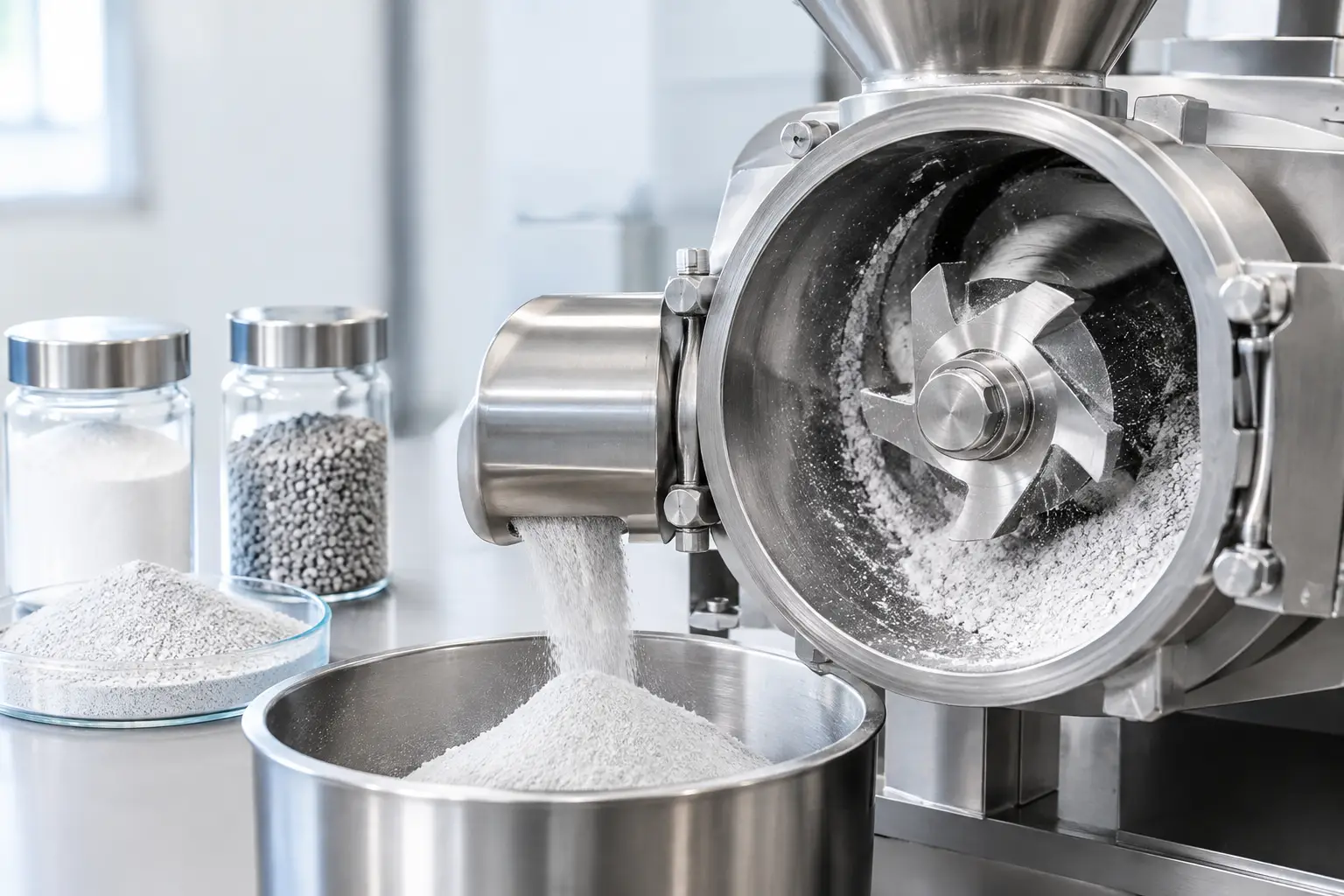
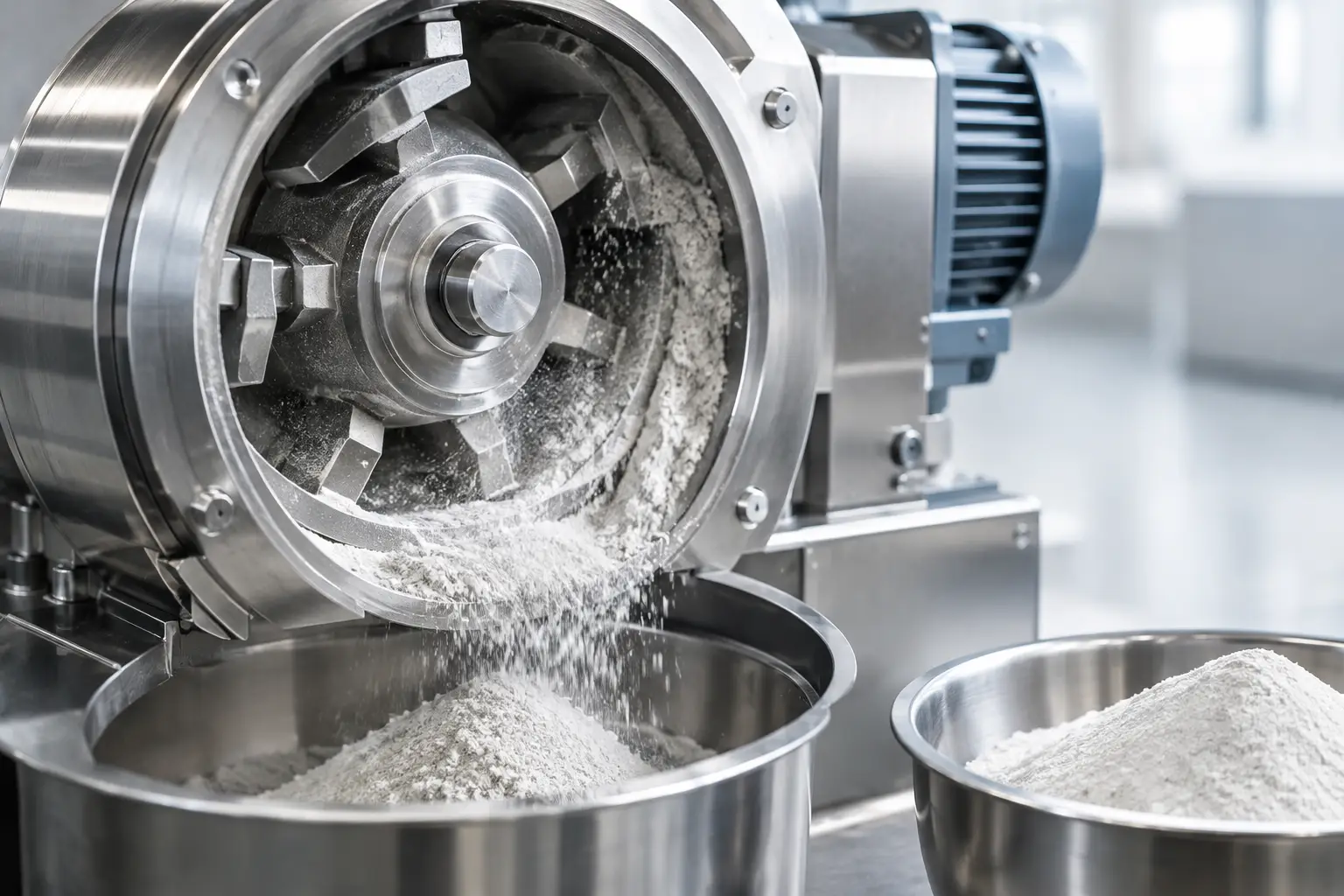
Equipment options:
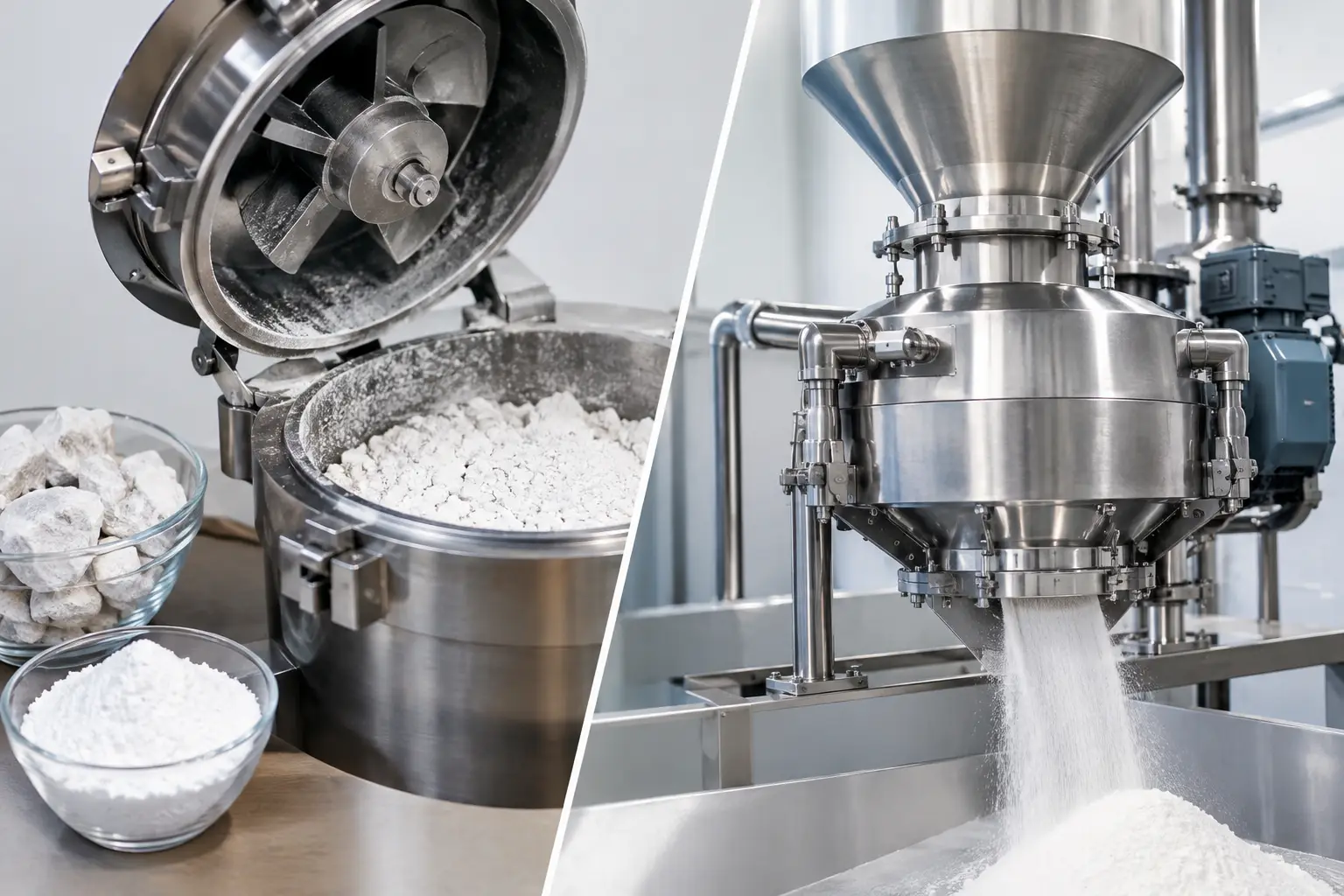
- Batch plow mixers (precision control)
- Continuous pin mills / turbo mills (high throughput)
- Hybrid systems combining both
5. Stabilization & Cooling
- Prevents re-agglomeration
- Locks in coating integrity
- Maintains free-flowing characteristics
6. Classification & Finishing
- Air classification for particle control
- Removal of oversize or undercoated particles
Process Optimization: What Separates Leaders from Commodity Producers
Uniformity of Coating
The most critical factor.
Poor coating leads to:
- Inconsistent product performance
- Customer rejection
- Processing issues downstream
Thermal Control
Not just temperature—but temperature distribution and control over time.
Shear & Mixing Dynamics
Too little:
- Poor coating coverage
Too much:
- Particle degradation
- Energy inefficiency
Residence Time Engineering
- Determines coating completeness
- Impacts throughput and profitability
Feed Consistency
- Variability in CaCO₃ feed leads to inconsistent coating quality
Common Industry Failures (And Why They Happen)
- Uneven coating due to poor injection systems
- Agglomeration caused by improper mixing dynamics
- Thermal hotspots degrading stearic acid
- Overcoating leading to greasy or unstable powders
- Undercooked material with poor hydrophobic performance
These failures are not equipment problems—they are process engineering problems.
The Business Case: Why Manufacturers Invest in Coating Systems
1. Increased Product Value
Coated CaCO₃ commands a higher price than uncoated material.
2. Market Expansion
Access to:
- Plastics
- Masterbatch
- High-performance materials
3. Customer Retention
Consistent coating = consistent product performance
4. Cost Optimization for End Users
- Higher filler loading
- Reduced resin usage
- Improved process efficiency
The Future of Mineral Processing
The industry is shifting from:
- Commodity production
➡️ to - Functional material engineering
Key trends include:
- Higher performance requirements
- Increased demand for consistency
- Integration of continuous processing systems
- Automation and process control
- Hybrid systems combining mixing, milling, and classification
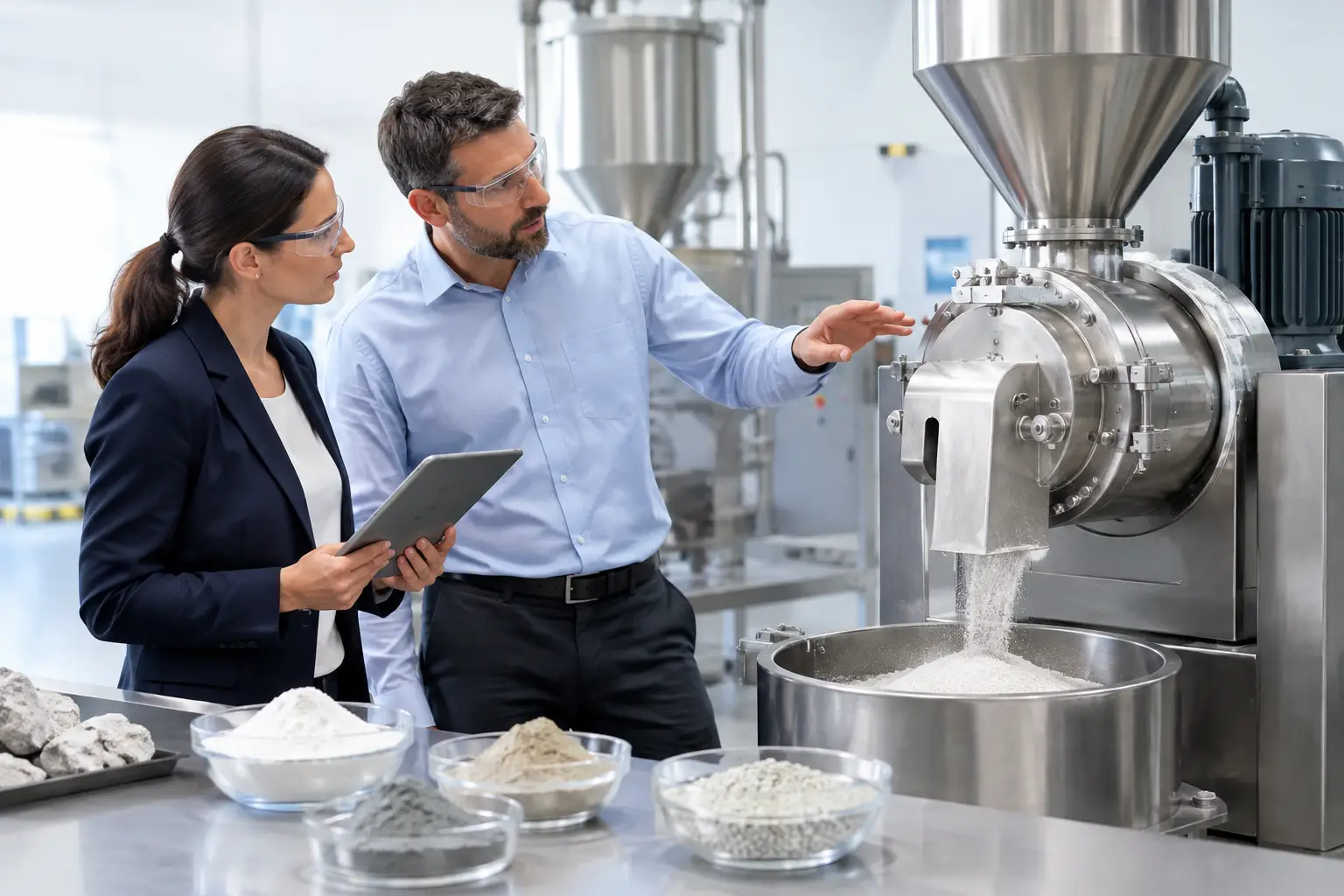
The DP Approach: Engineering Complete Coating Systems
Through the integration of:
- High-intensity mixing (PerMix)
- Advanced milling and classification (DP Pulverizers): Jet mills, pin mills, turbo mills
- Automated material handling (AIS)
We deliver:
- Batch and continuous coating solutions
- Precision thermal control
- Scalable systems from lab to full production
- Turnkey process lines engineered for performance and reliability
Conclusion: From Mineral to Engineered Material
Calcium carbonate is no longer just a filler.
With proper surface treatment, it becomes:
- A performance enhancer
- A cost optimization tool
- A critical component in advanced manufacturing
The companies that understand and control surface chemistry, process engineering, and system integration will lead the future of this industry.
At its highest level, stearic acid coating is not just a process.
It is the transformation of a mineral into a designed material with purpose.