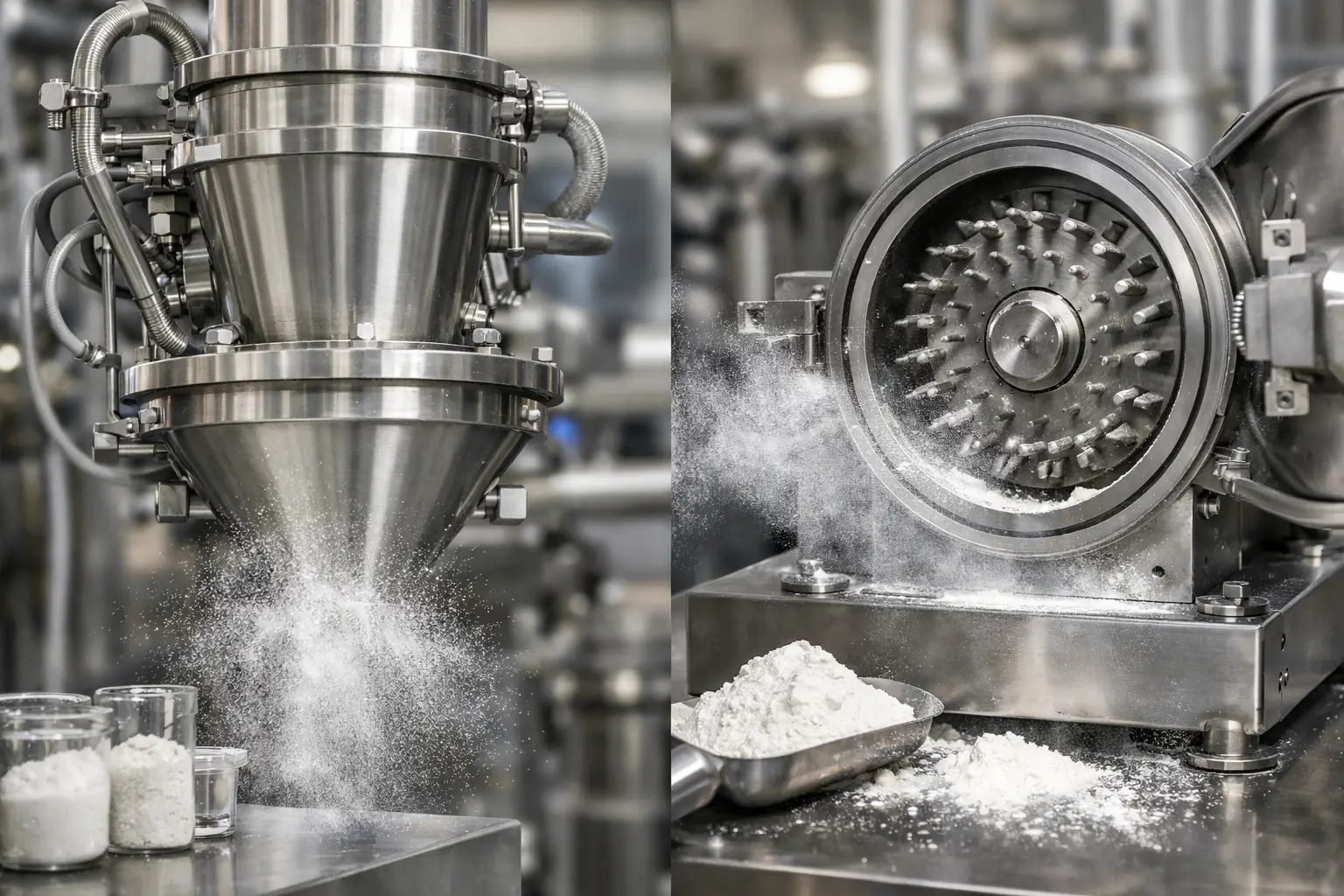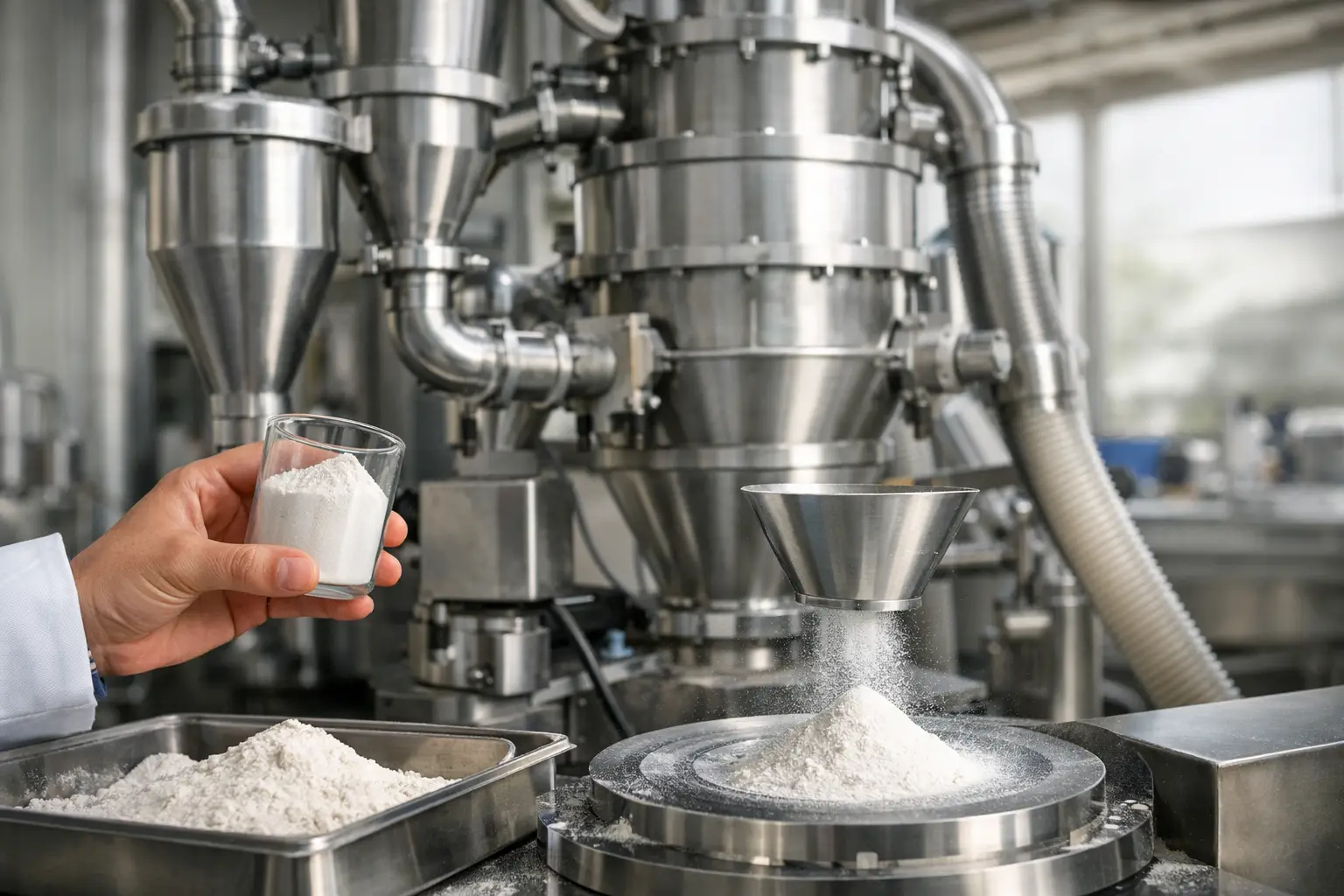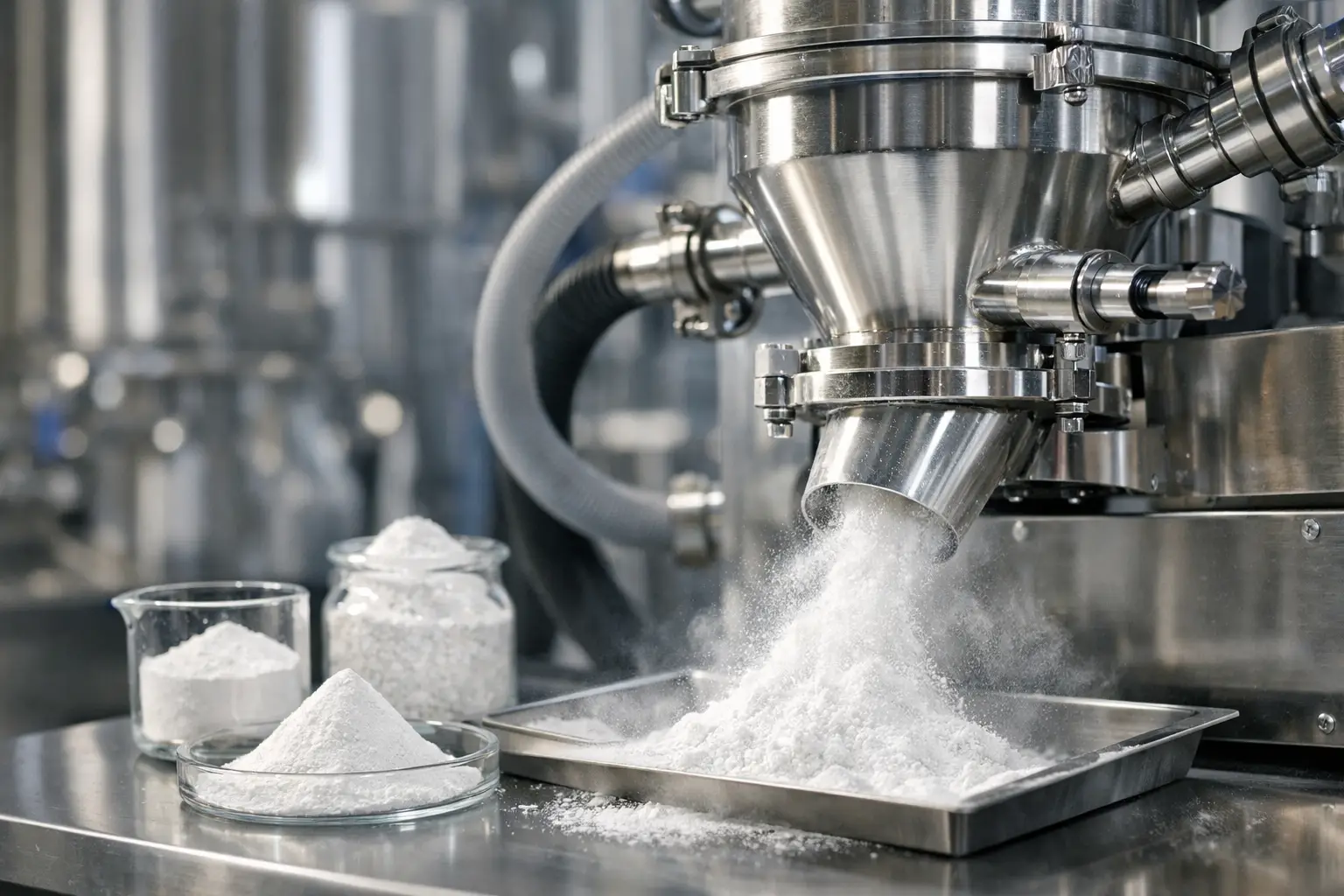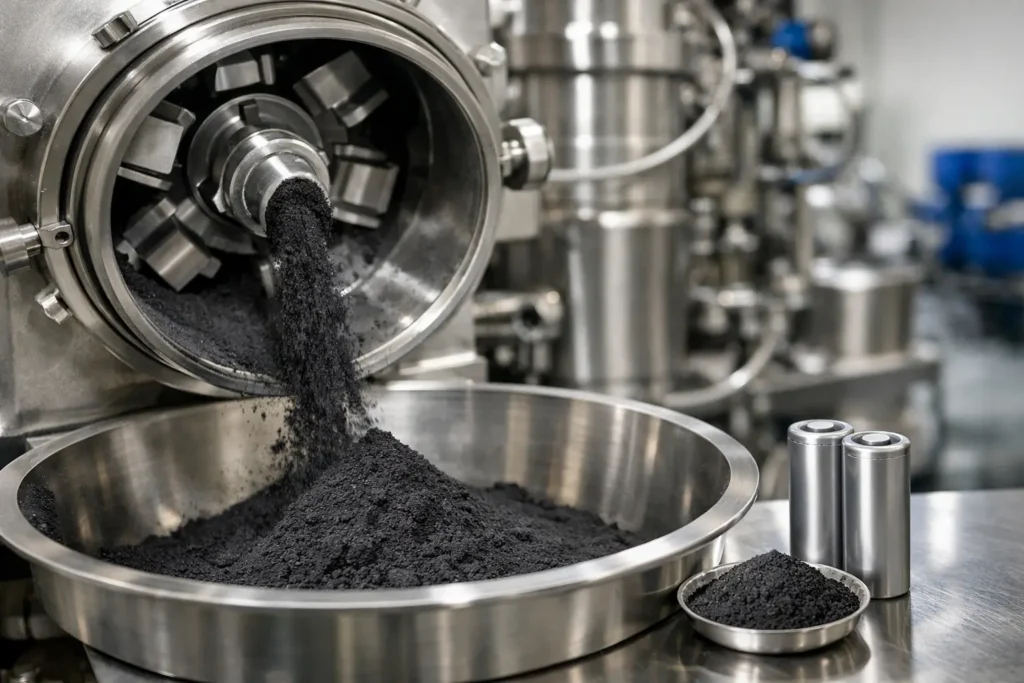
A battery line can lose performance long before cell assembly becomes the obvious problem. It often starts upstream, when powder processing introduces too much heat, too many oversize particles, or trace contamination that should never have entered the material stream. That is why battery material grinding systems are not simply size reduction equipment. They are process-critical systems that affect downstream mixing, coating, densification, and ultimately cell consistency.
Battery materials present a difficult combination of requirements. Many powders are fine, abrasive, heat-sensitive, reactive, or highly value-dense. A system that works well for conventional chemical powders may create major problems in battery production, especially when manufacturers need narrow particle size distribution, strict contamination control, and repeatable throughput at scale. Selecting the right grinding approach is less about choosing a machine category and more about engineering a system around material behavior and production targets.
What battery material grinding systems need to achieve
In battery manufacturing, particle size is tied directly to process performance. Cathode and anode materials, conductive additives, precursor compounds, and specialty powders all behave differently in milling, yet the production goals are similar. Manufacturers need consistent particle size distribution, low contamination, controlled temperature rise, predictable yield, and stable operation over long campaigns.
That creates trade-offs. Finer grinding may improve surface area and downstream reactivity, but it can also raise energy use, reduce throughput, and increase the risk of agglomeration. Higher impact forces may boost production rate, but they can damage particle morphology or generate unwanted heat. Tighter classification improves uniformity, but it can increase system complexity and recirculating loads. The right answer depends on the chemistry, the target specification, and where the powder goes next in the process.
Matching grinding technology to battery materials
Battery material grinding systems are rarely one-size-fits-all because battery powders do not fail in one-size-fits-all ways. Material hardness, friability, moisture sensitivity, oxidation risk, and target fineness all influence equipment selection.
Jet mills for high-purity fine grinding
Jet milling is often favored when very fine particle sizes and contamination control are top priorities. Because particle-to-particle collision drives size reduction, there is minimal mechanical contact with internal grinding components compared with conventional impact systems. That can be a major advantage for high-value battery powders where metallic contamination must be tightly controlled.
Jet mills are particularly useful when manufacturers need micron-scale particle size with narrow distribution and limited temperature rise. The trade-off is that jet milling is not always the best fit for every material or every throughput target. Compressed gas demand, operating cost, and feed behavior must all be evaluated carefully.
Air classifier mills for controlled PSD and throughput
Air classifier mills combine impact grinding with internal classification, making them a practical option for battery materials that require controlled top size and continuous production efficiency. They can offer strong flexibility when the process calls for a balance between fineness and throughput.
For some precursor materials and functional additives, this type of system can provide reliable control without the operating profile of a jet mill. That said, if contamination sensitivity is extreme or the target particle size moves deep into ultrafine territory, another technology may be more appropriate.
Pin mills, hammer mills, and universal mills for upstream conditioning
Not every battery powder application starts with final-stage micronization. In many production lines, upstream deagglomeration, delumping, or intermediate size reduction is just as important. Pin mills, hammer mills, and universal mills can play a valuable role in preparing material for fine grinding, improving feed consistency, or reducing oversized feed before a tighter final milling stage.
This matters because unstable feed creates unstable results. If material enters the final grinder with wide variability in bulk density, lump size, or moisture condition, the entire system becomes harder to control. In battery processing, upstream conditioning often has a direct effect on final quality.
Cryogenic grinding for heat-sensitive materials
Some battery-related materials become difficult to process as temperature rises. They may soften, smear, oxidize, agglomerate, or lose desired handling properties. Cryogenic grinding can help preserve material integrity by reducing process temperature and improving brittleness during size reduction.
This approach is not necessary for every battery application, but when heat is the factor limiting performance, it can shift the economics of the entire process. Instead of fighting temperature with lower throughput and compromised consistency, manufacturers can engineer around the material response itself.
Contamination control is not a secondary concern
In battery powder processing, contamination is often the issue that separates acceptable output from usable output. Wear from internal machine surfaces, poor system sealing, unsuitable contact materials, and inadequate dust handling can all introduce problems that become expensive much later in production.
That is why system design matters as much as mill selection. Contact surface materials, liner options, classifier construction, seal design, and dust collection strategy all affect contamination risk. Some applications benefit from ceramic-lined or specialized wear-resistant components. Others require inert gas operation to reduce oxidation or manage combustible dust concerns. The best battery material grinding systems are engineered with the full process environment in mind, not just the reduction chamber.
Heat management and particle integrity
Heat is one of the most common hidden variables in fine powder processing. A system may hit the target particle size while quietly damaging the material through thermal stress, altered surface chemistry, or increased agglomeration. In battery applications, those effects can influence slurry behavior, coating uniformity, and electrochemical performance.
Process engineers should look beyond nominal outlet temperature and evaluate where heat is generated, how long material resides in the system, and whether the grinding mechanism itself is inherently heat-intensive. Lower residence time, appropriate airflow, staged processing, or cryogenic support may all improve outcomes depending on the material.
Particle integrity also matters. Some battery powders perform best when the process preserves a specific morphology rather than simply forcing everything to a smaller size. Excessive impact or repeated recirculation can create fines that complicate handling and hurt downstream consistency. The system must achieve the target spec without overprocessing the material.
Throughput, yield, and scalability
Lab success does not automatically translate to plant performance. A grinding method that produces ideal samples in development can become unstable, costly, or maintenance-heavy at production rates. Battery manufacturers need systems that hold particle size targets while meeting output requirements and supporting practical uptime.
That means throughput should be evaluated alongside classification efficiency, yield loss, cleaning requirements, wear rates, and energy consumption. In some cases, a slightly broader particle size distribution may be acceptable if it delivers significantly better production economics. In others, the specification is tight enough that the system must prioritize control over raw throughput.
Scalability is especially important as battery production expands. Equipment should not be selected only for the current line rate. It should be considered in the context of pilot development, process transfer, and future capacity increases. Engineered flexibility can reduce the need for major process redesign later.
Why integrated system design matters
The most effective battery material grinding systems are not isolated machines. They are integrated process solutions that account for feeding, milling, classification, conveying, dust collection, containment, and controls. Weakness in any one of those areas can limit the entire line.
For example, an excellent mill will still underperform if the feed system causes surging, if the classifier is not tuned to the material, or if dust collection destabilizes airflow. Likewise, contamination control can be compromised by poor transfer points even when the mill itself is well designed. This is where application knowledge becomes essential. System performance depends on how the components work together under actual manufacturing conditions.
Manufacturers evaluating new or upgraded systems should ask practical questions early. How does the material respond to impact versus fluid-energy milling? What level of wear should be expected over time? Can the system maintain target PSD as feed characteristics shift? How will inerting, containment, and cleaning affect operating cost? Those answers typically matter more than a single capacity figure on a specification sheet.
For demanding powder applications, an engineering-driven approach is the safer path. Companies such as DP Mills support this process by aligning mill technology, material behavior, and production requirements into a system built for actual operating conditions rather than generic equipment selection.
Battery production continues to push tighter tolerances, higher output, and cleaner process control. Grinding systems have to keep pace. The manufacturers that treat powder processing as a strategic part of battery quality, not just a utility step, are usually the ones that build more stable production from the start.