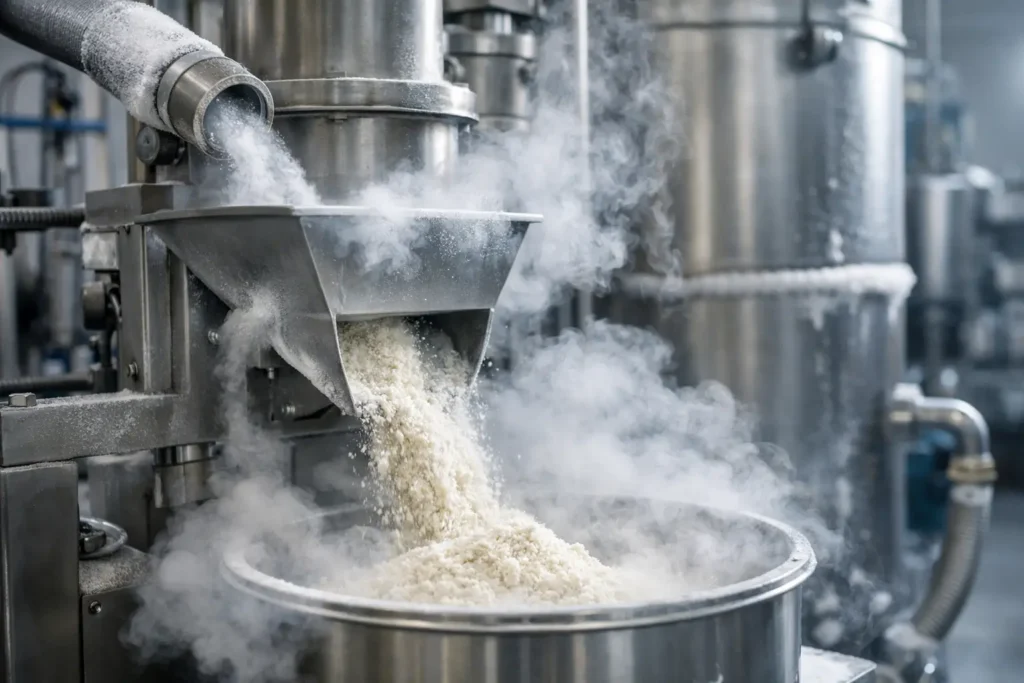
When a material softens, smears, oxidizes, or loses potency during milling, the problem is rarely the grinder alone. It is usually the combination of mechanical energy, rising product temperature, and the material’s own thermal limits. That is exactly why cryogenic grinding for heat sensitive materials has become a critical process strategy in pharmaceutical, food, chemical, nutraceutical, and advanced material manufacturing.
For many products, conventional ambient grinding introduces a basic conflict. You need enough energy to reduce particle size, but the same energy generates friction and heat that can damage the product before you reach the target specification. Cryogenic processing addresses that conflict by lowering the material temperature before and during size reduction, typically with liquid nitrogen or another controlled cooling method, so the product remains brittle and more stable throughout the milling cycle.
Why heat sensitive materials fail in conventional milling
Heat-sensitive materials do not all behave the same way, but the failure patterns are familiar. Some materials become elastic and resist fracture. Others melt at the surface, agglomerate in the mill, or coat internal components. In food and botanical applications, volatile compounds may flash off, reducing aroma, flavor, or functional value. In pharmaceuticals and nutraceuticals, elevated temperatures can affect active ingredients, excipient behavior, or content uniformity. In specialty chemicals and polymers, thermal exposure can trigger oxidation, discoloration, or structural change.
From a production standpoint, the effects go beyond product quality. Throughput drops when material begins to smear or blind screens. Cleaning time increases when deposits build up inside the system. Particle size distribution becomes harder to control because the material no longer fractures consistently. The result is a process that may still run, but not predictably and not efficiently.
How cryogenic grinding for heat sensitive materials works
The core principle is straightforward. The material is cooled to a temperature where it becomes more brittle and less prone to thermal degradation, then it is milled under controlled low-temperature conditions. In many systems, liquid nitrogen is introduced upstream for pre-cooling and may also be injected into the mill or conveyed through the process to maintain the required operating window.
That lower temperature changes the breakage behavior of the feed. Instead of deforming, smearing, or sticking, the material fractures more cleanly. This improves the ability of the mill to generate a narrower particle size distribution while reducing the heat-related side effects that often limit ambient grinding.
The exact system design depends on the application. Some materials only require pre-chilling before entering a pin mill, hammer mill, or turbo mill. Others need tightly controlled cryogenic conditions through feeding, milling, classification, and collection. The right answer depends on the material’s glass transition temperature, volatility, desired particle size, required throughput, and sensitivity to oxygen, moisture, or contamination.
Where cryogenic grinding delivers the most value
Cryogenic grinding is especially effective when product quality is directly tied to temperature control. Spices, herbs, and flavor ingredients are a common example. Ambient milling can drive off essential oils and alter flavor intensity, while low-temperature processing helps preserve volatile compounds and improve powder flow.
In pharmaceutical and nutraceutical manufacturing, cryogenic methods can support milling of waxy actives, polymers, temperature-sensitive compounds, and elastic excipients that are difficult to process at room temperature. For chemical and polymer applications, cryogenic systems are often used when materials become tough or gummy under standard conditions, making conventional size reduction inefficient or inconsistent.
Battery and advanced material producers also evaluate cryogenic processing where thermal exposure can affect material morphology, oxidation behavior, or downstream performance. In these environments, the benefit is not simply colder operation. It is better control over the mechanical response of the material during comminution.
Performance gains and practical trade-offs
Cryogenic grinding can improve particle size control, protect product integrity, reduce agglomeration, and increase process stability. It can also make previously difficult materials commercially viable at production scale. That said, the decision is not just about whether the method works. It is about whether it works better than the alternatives for your material, quality targets, and operating economics.
Liquid nitrogen consumption is the most obvious trade-off. Cooling adds operating cost, and that cost has to be evaluated against yield improvement, reduced waste, higher throughput, lower cleaning burden, and better finished product performance. For some high-value materials, the economics are clear. For lower-margin products, the value case depends on how severely heat affects quality and productivity under ambient conditions.
There is also a process control component. Cryogenic systems require proper instrumentation, temperature management, feed consistency, and venting design. If the cooling profile is not matched to the material and mill configuration, you can overuse nitrogen without achieving the expected particle size or throughput benefit. Engineering matters here because cryogenic grinding is not just a colder version of standard milling. It is a process with different material behavior, handling requirements, and optimization points.
Equipment selection matters more than many teams expect
The milling technology used in a cryogenic system still has to match the breakage mechanism of the product. A brittle material at low temperature may perform well in a pin mill, while another application may require a hammer mill, air classifier mill, or an integrated system with controlled conveying and collection. Feed rate, rotor speed, screen selection, classifier settings, and thermal retention time all influence final performance.
This is where many projects get delayed. A team may correctly identify heat as the problem but assume any cryogenic setup will solve it. In practice, system architecture determines whether the process delivers stable particle size, acceptable nitrogen efficiency, and scalable throughput. The feeder has to handle cold product reliably. The mill has to apply the right impact or attrition forces. The collection system has to manage fine powders at low temperature without excessive buildup or loss.
For manufacturers moving from lab success to production scale, this becomes even more important. A material that mills well in small cryogenic batches may behave differently in continuous operation, where residence time, thermal load, and mass flow all change. Scale-up should account for more than target particle size. It should also consider uptime, cleanability, yield, containment, and utility demand.
What to evaluate before specifying a cryogenic system
A successful project starts with the material, not the equipment brochure. Teams should understand the temperature range where the material becomes sufficiently brittle, the point at which degradation begins, and how particle size affects downstream processing or product performance. That information guides both mill selection and cooling strategy.
It is also important to define the real production objective. Some operations need a finer grind. Others need better preservation of active compounds, reduced oxidation, less caking, or more consistent bulk density. Cryogenic grinding may support all of these outcomes, but system design priorities will shift depending on which metric matters most.
Testing is typically the fastest way to reduce risk. Well-structured trials can show how the material responds at different temperatures, what particle size distribution is achievable, how much nitrogen is required, and whether the product remains stable after milling. Those results often reveal whether cryogenic grinding should be treated as a full-time production method or a targeted solution for specific product lines.
Cryogenic grinding for heat sensitive materials in modern production
As manufacturing tolerances tighten and product value increases, thermal control during size reduction becomes less of a niche consideration and more of a process requirement. This is especially true where particle size consistency, contamination reduction, volatile retention, or functional performance directly affect downstream results.
For processors evaluating new systems, the right question is not simply whether cryogenic grinding for heat sensitive materials is possible. The better question is whether it will improve the total process enough to justify implementation. In many cases, the answer is yes, but only when the system is engineered around the material’s real behavior and the production line’s actual operating demands.
That is why experienced manufacturers look beyond basic machine capability and focus on application fit, thermal control strategy, and long-term process reliability. DP Mills supports that kind of evaluation by approaching cryogenic milling as an engineered process solution rather than a standard equipment package.
When heat is the factor that keeps a material from milling cleanly, consistently, and at scale, lowering the temperature can change the entire economics of the operation.