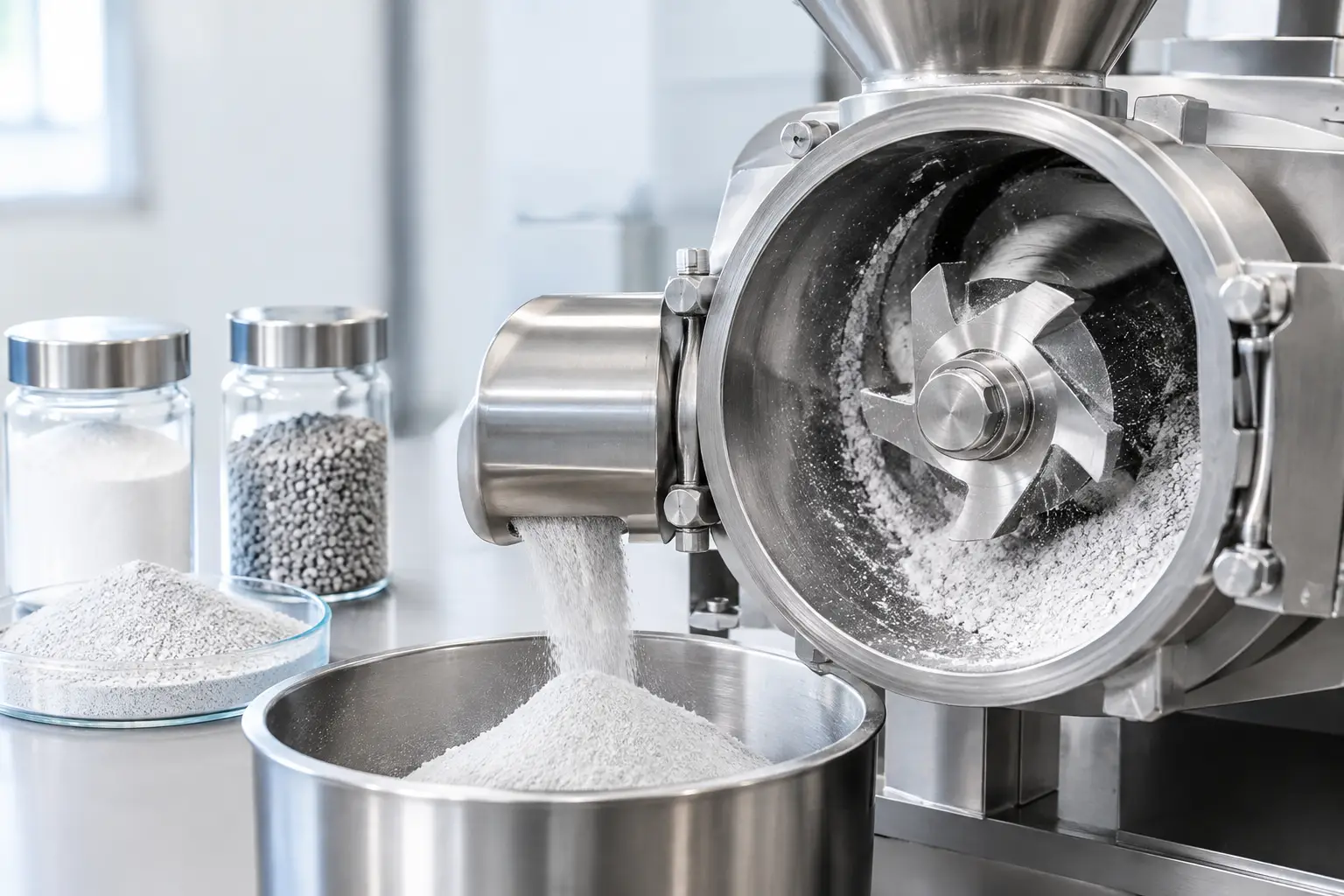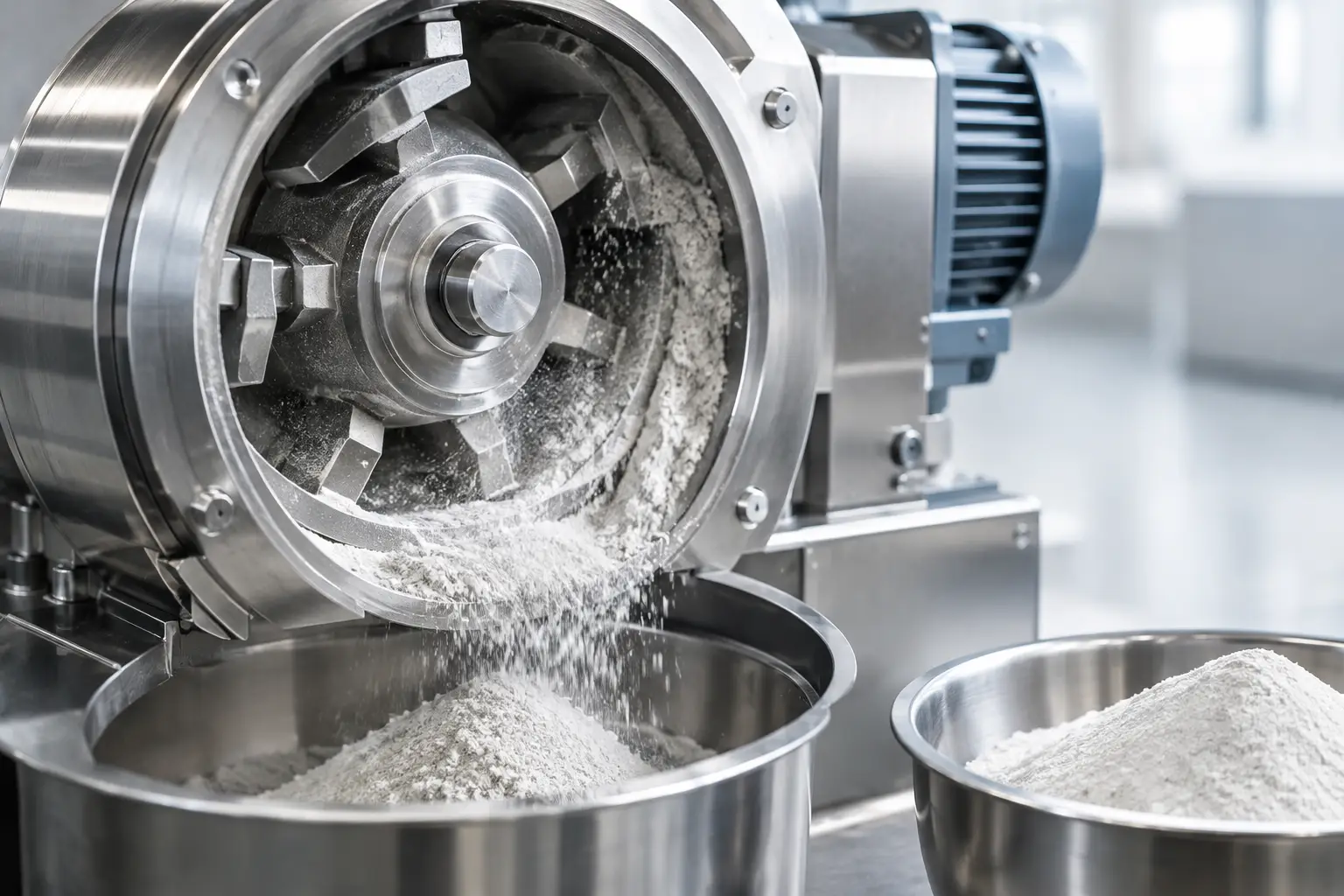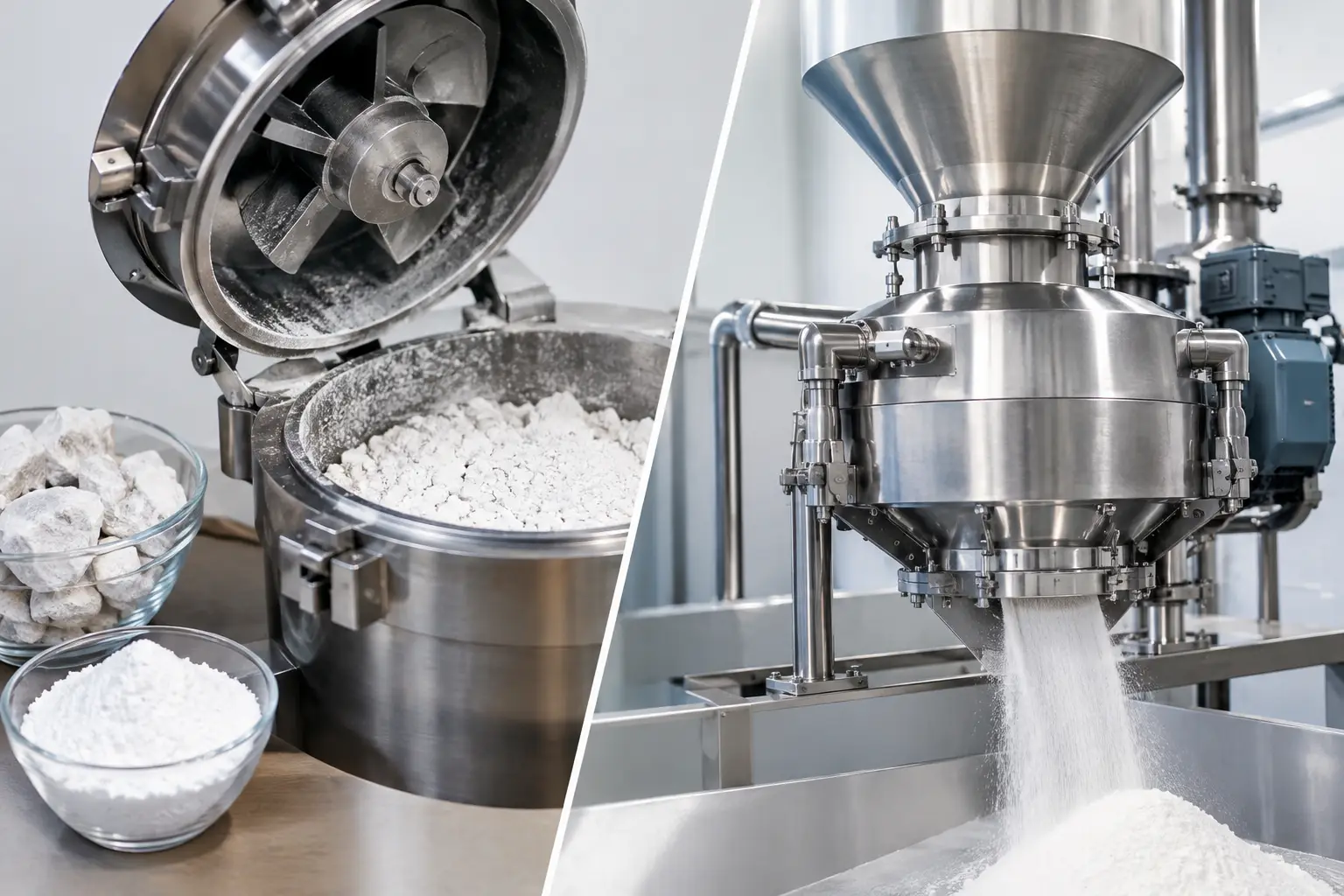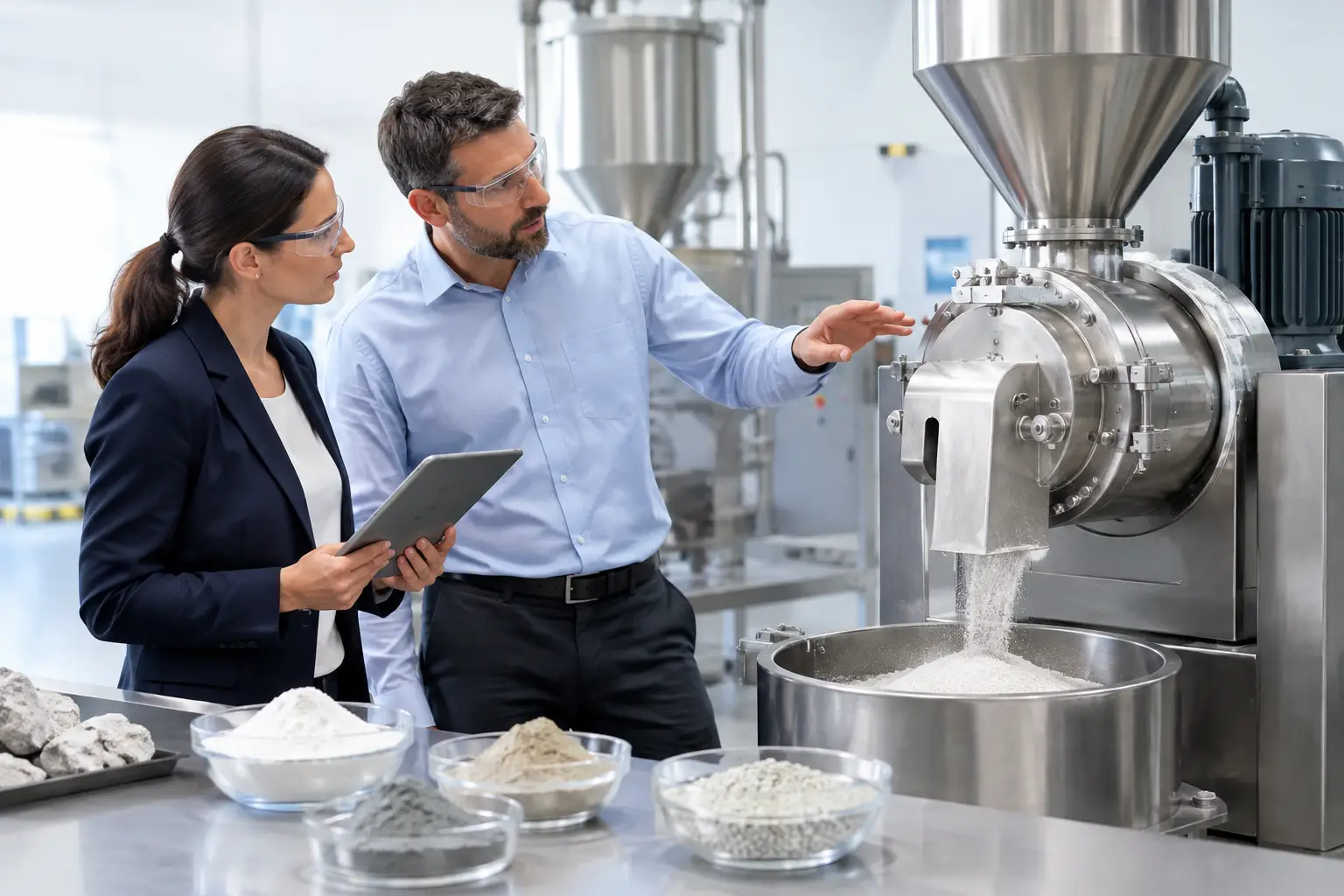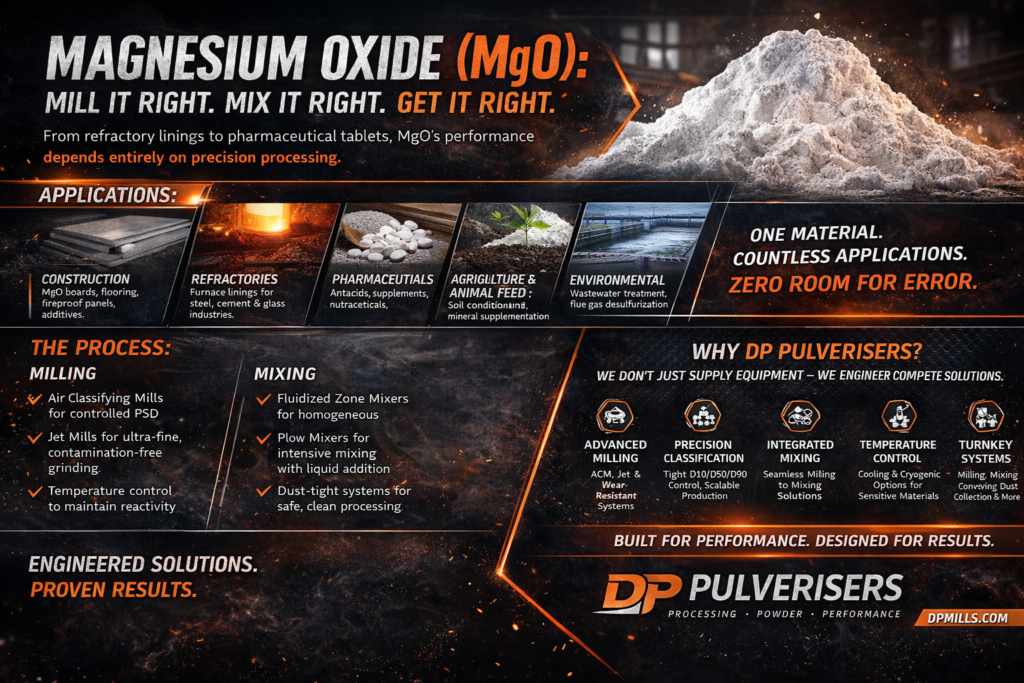
Milling Magnesium Oxide (MgO): The Hidden Complexity Behind a “Simple” Powder — And How to Process It Right
Magnesium Oxide (MgO) is everywhere—yet almost no one talks about how difficult it actually is to process correctly.
From refractory linings in steel plants to pharmaceutical tablets and nutraceutical powders, MgO plays a critical role across industries. But here’s the truth:
If your milling is off, your product fails.
If your mixing is inconsistent, your performance drops.
And in highly competitive markets, that’s the difference between winning and losing customers.
What is Magnesium Oxide (MgO)?
Magnesium Oxide is produced by calcining magnesium carbonate (magnesite) or extracting from seawater brines. The calcination temperature determines the final product characteristics—primarily reactivity, density, and application suitability.
Key Grades:
- Caustic Calcined MgO (CCM) → Highly reactive, used in agriculture, chemicals, and environmental applications
- Dead Burned MgO (DBM) → Dense, low reactivity, ideal for refractories and high-temperature applications
- Fused MgO → Ultra-pure, extremely high temperature resistance
- Pharmaceutical Grade MgO → Tight particle size control, ultra-low contamination
Each of these requires completely different processing strategies—especially when it comes to milling and mixing.
Where MgO is Used (And Why Processing Matters)
MgO is not a one-size-fits-all material. Its performance is directly tied to particle size, surface area, and homogeneity.
Major Applications:
- Construction & Building Materials
- MgO boards, fireproof panels, flooring systems
- Cement additives requiring controlled reactivity
- Refractories
- Furnace linings in steel, cement, and glass industries
- High-density, heat-resistant materials
- Pharmaceuticals & Nutraceuticals
- Antacids, magnesium supplements
- Requires ultra-fine, sterile, and consistent powders
- Agriculture & Animal Feed
- Soil conditioning and mineral supplementation
- Uniform blending is critical for dosage consistency
- Environmental Applications
- Wastewater treatment
- Flue gas desulfurization
👉 In every one of these industries, particle size distribution and mixing uniformity directly impact performance.
Milling MgO: Where Most Systems Break Down
MgO is one of those materials that looks easy—until you actually try to grind it properly.
Core Challenges:
- Highly abrasive → Rapid wear on standard equipment
- Heat sensitivity → Excess heat reduces reactivity
- Agglomeration at fine sizes → Particles re-clump after grinding
- Wide PSD requirements → From coarse powders to sub-micron particles
Typical Particle Size Targets:
- Construction: 50–200 microns
- Agriculture: 75–150 microns
- Pharmaceuticals: <10 microns (often D90 < 5 µm)
- Advanced materials: Sub-micron
The Reality:
Not all mills can handle MgO effectively. Poor equipment leads to:
- Inconsistent particle size
- Reduced product performance
- Increased maintenance costs
- Contamination risks
Proven Milling Solutions:
- Air Classifying Mills (ACM) → Precise PSD control, scalable production
- Jet Mills → Ultra-fine grinding with minimal contamination
- Cryogenic / temperature-controlled systems → Maintain material integrity
Mixing MgO: The Silent Failure Point
Even after perfect milling…most systems fail during mixing.
Why?
Because MgO behaves differently than most powders:
- Low bulk density → poor flowability
- Fine particles → dusting and segregation
- Moisture sensitivity → clumping and reaction
- Electrostatic effects → uneven distribution
What Happens with Poor Mixing:
- Inconsistent product performance
- Segregation during transport
- Poor downstream processing
- Customer complaints (the expensive kind)
What You Actually Need:
- Uniform blending across all particle sizes
- Controlled shear (not too aggressive, not too gentle)
- Dust-tight systems with proper venting
- Liquid addition capability (binders, modifiers, coatings)
Best Mixing Technologies:
- Fluidized Zone Mixers → Exceptional homogeneity for fine powders
- Plow Mixers → High-intensity mixing with liquid injection capability
- Ribbon Blenders → Cost-effective, but limited for ultra-fine MgO
The Real Complications in MgO Manufacturing
This is where expertise separates average suppliers from true process partners.
1. Agglomeration After Milling
Fine MgO particles tend to re-bind, undoing your grinding effort.
2. Moisture Reactivity
MgO reacts with water → forming magnesium hydroxide
This impacts:
- Shelf life
- Flowability
- Chemical performance
3. Heat Control
Excess heat during milling reduces reactivity—especially critical for CCM grades.
4. Equipment Wear & Contamination
MgO is abrasive. Without the right materials of construction:
- You contaminate your product
- You increase downtime
- You burn through maintenance budgets
5. Dust & Handling
Fine MgO requires:
- Proper dust collection
- Sealed systems
- Safe handling design
Who Manufactures MgO Products?
The MgO market includes:
- Global mining and mineral processing companies
- Specialty chemical manufacturers
- Pharmaceutical ingredient producers
- Refractory product manufacturers
What do they all have in common?
👉 Their success depends on precision processing—not just raw material supply.
Why DP Pulverisers is a Leader in MgO Processing
This is where most companies fall short—they sell machines.
DP Pulverisers engineers complete solutions.
What Sets DP Pulverisers Apart:
Advanced Milling Technology
- Air Classifying Mills for controlled particle size distribution
- Jet Mills for ultra-fine, contamination-free processing
- Wear-resistant designs built specifically for abrasive materials
Temperature-Controlled Grinding
- Integrated cooling systems
- Cryogenic solutions for sensitive applications
Precision Classification
- Tight control over D10 / D50 / D90
- Consistent, repeatable product quality
Integrated Process Systems
- Seamless connection between milling, conveying, and mixing
- Fully engineered systems—not standalone machines
Turnkey Capability
- Milling + mixing + conveying + dust collection
- Designed for food, pharmaceutical, and chemical compliance
The Bottom Line
Magnesium Oxide is not just another powder.
It’s a material where processing defines performance.
If you get it right:
- Better product consistency
- Higher performance
- Stronger market position
If you get it wrong:
- Rework
- Waste
- Lost customers
Final Thought
In a world where materials are becoming more specialized and performance-driven, the companies that win are the ones that control their process—not just their raw materials.
That’s where DP Pulverisers leads.